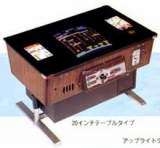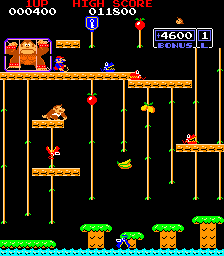
Donkey Kong Jr. © 1982 Nintendo.
Donkey Kong Jr. is a single-screen platform game and the first sequel to the legendary original. It differs from the first game in that Mario is now cast as the villain (the only Mario game in which this occurred) and Donkey Kong the captured victim.
Donkey Kong's son, DK Junior, must rescue his captured father from Mario's clutches by climbing and jumping his way over vines, chains and platforms in order to grab a key and reach his father. Junior has to race against time while avoiding the horrible Snap jaws and birds released by Mario.
Junior can run left and right, jump, and grab vines/chains/ropes to climb higher up the screen. He can slide down faster by holding only one vine, or climb faster by holding two. To pass the first three stages, Junior must reach the key hanging next to his father's cage, whereupon Mario flees while pushing the cage off-screen. In the fourth stage, Junior must push six keys into locks on the topmost platform to free Donkey Kong. After a brief cutscene, the player is taken back to the first stage at an increased difficulty.
Items of fruit litter the stages and these can be knocked down for bonus points, they can also be dropped onto enemies and will kill every enemy they touch before falling off the bottom of the screen. Junior loses a life when he touches any enemy or projectile, falls too great a distance, or falls off the bottom of the screen. Additionally, he loses a life if the bonus timer counts down to zero. Donkey Kong Jr. features four different stages.
CAST OF CHARACTERS:
* Junior: Baby ape and son of Donkey Kong, he must rescue his father from Mario's cage.
* Mario: Imprisoned Donkey Kong after the ape's escapades in the first game and now keeps a watchful eye over his prisoner.
* Donkey Kong: From villain to victim, Kong must watch helplessly as his son comes to his rescue.
* Snap Jaws: Mechanical mouths that must be avoided. Blue jaws drop down vines and continue off the bottom of the screen, red jaws climb back up and pose a more permanent threat.
* Nitpickers: Flying birds of which there are two types: small ones appear in the Springboard stage and attempt to drop eggs on Junior as they fly around the top branches. Fatter ones appear on the Chains stage and weave back and forth to hinder Junior.
* Sparks: These volts of electricity patrol Mario's Hideout. The red variety follows the loop that they begin on, while the blue ones follow the vertical strips from one level to the next as they drop to the bottom of the screen.
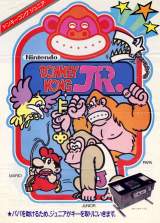
Main CPU : Zilog Z80 (@ 3.072 Mhz)
Sound CPU : I8035 (@ 400 Khz)
Sound Chips : DAC
Players : 2
Control : 4-way joystick
Buttons : 1 (JUMP)
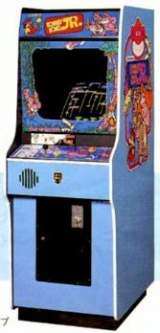
Donkey Kong Jr. was released in August 1982 in Japan.
The US version, as well as some bootleg versions, have the suffix fully spelled out in the printed title rather than abbreviated (Donkey Kong Junior).
The music that is played in the intro sequence before gameplay is the opening of Bach's 'Toccata and Fugue in D Minor'.
The song that is played during the cut scene before the Mario's Hideout Stage is from the 'Can-Can'.
Steve Wiebe holds the official record for this game with 1,139,800 points on March 14, 2009.
Bootlegs of the game include Donkey King Jr. and Junior King. Another bootleg runs on the Moon Cresta hardware.
| Jump over one opponent | 100 points |
| Jump over two or more opponents | 300 points |
| Pick a fruit | 400 points |
| Hit first opponent with fruit | 800 points |
| Hit second opponent with fruit | 1,200 points |
| Hit third and subsequent opponents with fruit | 1,600 points |
| On the Chains Stage only | |
| Push key in lock | 200 points |
 (1982)
  Nintendo Famicom (jul.15, 1983) Donkey Kong Jr. [Model HVC-JR] Nintendo NES (june.15, 1987) Donkey Kong Jr. [Model NES-JR-EEC] (jul.19, 1988) Donkey Kong Jr. [Model FMC-JRD] (1984)