

Gauntlet II © 1986 Atari Games.
Gauntlet II is a direct sequel to the legendary maze-based fantasy themed shoot-em-up, released a year earlier. Atari chose not to tinker with the core game-play mechanic to any great degree, opting instead to enhance the already excellent multi-player action that had created such a stir upon the original game's release.
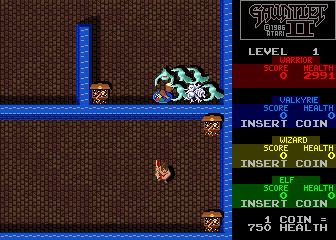
As with its prequel, up to four players once again take on the role of either 'Thor the Warrior', 'Thyra the Valkyrie', 'Merlin the Wizard', or 'Questor the Elf' and must play cooperatively as they explore and fight their way through the enemy-packed mazes, collecting potions, food and treasure as they searched for the exit that would lead them to the next dungeon.
Changes to the sequel included the ability for players to play whatever character they wanted, even if that character was already in play. Characters were now colour-coded and players would find themselves taking on the role of 'Blue Elf', 'Green Wizard', etc. New in-game speech was added to allow for the new player definitions.
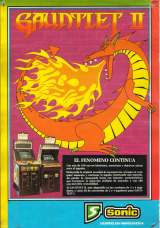
Other changes included the ability to 'bounce' shots off walls - known as 'Reflective Shots' - providing the correct potion was picked up. As well as new potions, Gauntlet II also featured several new monsters. The most notorious of the new additions was the Fire-breathing Dragon that guards the exit to some dungeons. This powerful creature takes multiple hits to kill and defeating it would see the players rewarded with a permanent potion and a bag of treasure.
Another notable addition was the 'It' monster: any player who was tagged by the creature would suddenly find that all of that level's monsters would ONLY chase the tagged player, completely ignoring the presence of all other players. The only way to remove this curse was to tag another player, thus making them 'it'.
New level elements were also added to further increase variety. These included dungeons with entirely invisible walls, magical walls (which changed into monsters or items when hit), stun tiles (which stunned any player that walked on them) and exits that flashed between functioning and non-functioning.
Game ID : 136043
Main CPU : Motorola 68010 (@ 7.15909 Mhz), MOS Technology 6502 (@ 1.789772 Mhz)
Sound Chips : Yamaha YM2151 (@ 3.579545 Mhz), POKEY (Pot Keyboard Integrated Circuit) (@ 1.789772 Mhz), Texas Instruments TMS5220 (@ 650.826 Khz)
Players : 4
Control : 8-way joystick
Buttons : 2
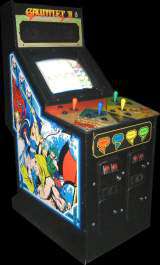
The original Gauntlet was released in October 1985, with the Gauntlet II conversion kits coming out nearly a year later, in August 1986. A lot of the original Gauntlet machines of the time were switched over to Gauntlet II cabinets. They tended to stay as Gauntlet II for some time, due to the relative scarcity of kits that would convert a Gauntlet cabinet to that of its sequel. The proper kits were uncommon until the late eighties, by which time four-player games were taking off in a big way.
Only 209 dedicated units were produced. The selling price was $2,295.
3,250 '4-Player kits' were produced. Selling price: $595
Only 61 '2-Player kits' were produced. Selling price: $395
Competition : Atari held a promotional competition to coincide with "Gauntlet II's" initial launch. If players followed the instructions the game gives before entering a secret room (the machine provides clues on how to enter the secret rooms whenever a hidden wall is shot away on any level), the player is greeted with a screen explaining that they had been awarded extra points and inviting the player to enter his or her name.
A six-digit code would then be given which the player could put onto a competition entry form. The first 500 entries drawn won Gauntlet II T-shirts, plus a chance of winning a $5000 savings bond. Machines can also be set (via dip switches) to suppress this screen, in which case players would get a screen saying '5000 points x coins = xxx' after doing the secret room. The contest ended in 1986.
Note : the game contains exactly 205 sounds! (including digitized voices, effects and musics), less than the first Gauntlet.
Pony Canyon / Scitron released a limited-edition soundtrack album for this game (That's Atari Music Vol.II : G.S.M. Atari Games 2 - PCCB-00070) on September 21, 1991.
| Key | 100 points. |
| Treasure | 100 - 500 points. |
| Each type of monster has a set score value. | |
| Each generator is worth twice as many points as its associated monster. | |
| Death | up to 6,000 points. |
 Nintendo NES (sept.1990) Gauntlet II [Model NES-2U-USA]
  Nintendo NES (apr.25, 1991) "Gauntlet II [Model NES-2U]"
  (2004) Midway Arcade Treasures 2 Microsoft XBOX (oct.11, 2004) "Midway Arcade Treasures 2 [Model MWO-3201W]" (oct.11, 2004) Midway Arcade Treasures 2 [Model DOL-GAYE-USA] Sony PS2 (oct.11, 2004) Midway Arcade Treasures 2 [Model SLUS-20997] Microsoft XBOX (oct.29, 2004) Midway Arcade Treasures 2 Sony PS2 (oct.29, 2004) Midway Arcade Treasures 2 [Model SLES-52844] (may.3, 2007) (june.29, 2007) (nov.6, 2012) Midway Arcade Origins (nov.6, 2012) Midway Arcade Origins [Model BLUS-31083] Microsoft XBOX 360 (nov.15, 2012) Midway Arcade Origins (nov.15, 2012) Midway Arcade Origins [Model BLES-01768] Nintendo Game Boy (1991) "Gauntlet II [Model DMG-G2-NOE]" Nintendo Game Boy (sept.1991) Gauntlet II [Model DMG-G2-USA] (1986) "Gantelet II" Amstrad CPC (1987) Commodore C64 (1987) (1987) Sinclair ZX Spectrum (1988) (1989) (1989) PC [MS Windows, CD-ROM] (feb.17, 2006) Midway Arcade Treasures Deluxe Edition PC [MS Windows, CD-ROM] (mar.17, 2006) Midway Arcade Treasures Deluxe Edition by Zoo Digital Publishing