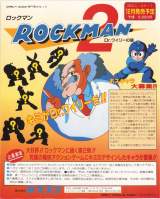
![Rockman 2 - Dr. Wily no Nazo [Model CAP-XR] screenshot](images/game/54548_1.png "Rockman 2 - Dr. Wily no Nazo [Model CAP-XR]")
Rockman 2 Dr.ワイリーの謎 © 1988 Capcom Company, Limited.
(Rockman 2 - Dr. Wily no Nazo)
Rockman 2 continues the titular protagonist's battle against the evil Dr. Wily and his rogue robots. The game features graphical and gameplay changes from the first game, many of which have remained throughout the series.
![Goodies for Rockman 2 - Dr. Wily no Nazo [Model CAP-XR]](images/covermini160/54548_1.jpg)
GAME ID: CAP-XR
BARCODE: 4976219012133
Rockman 2 was released on December 24, 1988 (Saturday) in Japan.
Though sales for Rockman were unimpressive, Capcom allowed the Rockman team to create a sequel. They worked concurrently on other Capcom projects, using their free time to develop the game. Due to the limited amount of cartridge space available for the first game, elements such as planned enemy characters were omitted from the final product. The unused content from the previous title was integrated into Rockman 2.
According to Roy Ozaki, director Akira Kitamura had wanted to make a sequel to Mega Man, but producer Tokuro Fujiwara was against it. Kitamura then went to Capcom Vice-President to get permission to make the game. Capcom allowed the development team to create a sequel on the condition that they work concurrently on other projects as well. The staff spent their own time on the project to improve upon the original by adding more levels and weapons, as well as improving the graphics. The project supervisor of the first Rockman invited Inafune to the sequel's development crew; Inafune was working on a separate game at the time. On the previous game, Inafune worked as an artist and character designer but became more involved in the production process of the sequel.
The development time for the game was only three to four months.
The gameplay system from the original game was kept for Mega Man 2, but the team included more traps for the player to navigate. The game's three support items were added to aid the player because of complaints from consumers and Capcom's marketing department regarding the original game's high difficulty. Inafune's supervisor was especially unsure about the usefulness of the Energy Tanks.
The first game did not have any influence from fans, but for the second game, Kitamura wanted to get ideas from players and put them in. The developers allowed input from the public by including boss designs created by fans. Capcom received 8,370 boss submissions for the game, although even the designs for the final eight Robot Masters were tweaked.
Inafune intended his artwork for Mega Man 2 to be more "anime-ish" than in the first game.
Tateishi's initial compositions for the game were of varying moods, with some of them being considered too cute by Kitamura, requesting them to be changed to fit in with the rest of the soundtrack. A single fragment of this declined concept remains in the game as Crash Man's stage theme. The widely praised piece used for the first two Wily stages was heavily compromised due to data limitations, with Tateishi being forced to use the first eight measures of the song multiple times throughout it. Intent to compose a song exclusive to the second stage was quickly abandoned for the same reasons.
Inafune claims the success of Rockman 2 is what made the Rockman series a hit that continues to spawn sequels.
Reviews:
[JP] Famitsu (January 1989): 28/40
Export releases:
Mega Man II [Model NES-XR-USA] (1989)
Mega Man II [Model NES-XR-EEC] (1990)
Mega Man II [Model NES-XR-FRA] (1990)
Mega Man II [Model NES-XR-FRG] (1990)
Mega Man II [Model NES-XR-NOE] (1990)