

Apple IIe © 1983 Apple Computer Co.
Microprocessor:
- 6502 or 65C02 running at 1.023 MHz
- 8-bit data bus
Memory:
- 64 KB RAM built-in
- 16 KB ROM built-in
- Expandable from 64 KB up to 1 MB RAM or more
Video modes:
- 40 and 80 columns text, white-on-black, with 24 lines¹
- Low-Resolution: 40×48 (15 colors)
- High-Resolution: 280×192 (6 colors)²
- Double-Low-Resolution: 80×48 (15 colors)
- Double-High-Resolution: 560×192 (15 colors)²
¹ Text can be mixed with graphic modes, replacing either bottom 8 or 32 lines of graphics with four lines of text, depending on video mode
² effectively 140×192 in color, due to pixel placement restrictions
Audio:
- Built-in speaker; 1-bit toggling
- Built-in cassette recorder interface; 1-bit toggle output, 1-bit zero-crossing input
Expansion:
- Seven Apple II Bus slots (50-pin card-edge)
- Auxiliary slot (60-pin card-edge)
Internal connectors:
- Game I/O socket (16-pin DIP)
- RF modulation output (4-pin Molex)
- Numeric keypad (11-pin Molex)
External connectors:
- NTSC composite video output (RCA connector)
- Cassette in/out (two 1?8-inch mono phono jacks)
- Joystick (DE-9)
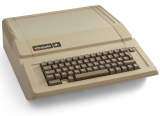
Apple had planned to retire the Apple II series after the introduction of the Apple III in 1980; after that machine turned out to be a disastrous failure, management decided the further continuation of the Apple II was in the company's best interest. So after three and a half years at a stand-still, came the introduction of a new Apple II model — the Apple IIe (codenamed Diana and Super II). The Apple IIe was released in January 1983, the successor to the "Apple II Plus". Some of the hardware and software features of the Apple III were borrowed in the design of the Apple IIe. The culmination of these changes led to increased sales and greater market share of both home and small business use.
One of the most notable improvements of the Apple IIe is the addition of a full ASCII character set and keyboard. The most important addition is the ability to input and display lower-case letters. Other keyboard improvements include four-way directional cursor control and standard editing keys (Delete and Tab), two special Apple modifier keys (Open and Solid Apple), and a safe off-to-side relocation of the Reset key. The auto-repeat function (any key held down to repeat same character continuously) is now automatic, no longer requiring the REPT key (now gone) found on the previous model's keyboard.
The machine came standard with 64 KB RAM, with the equivalent of a built-in Apple Language Card in its circuitry, and had a new special Auxiliary slot (replacing slot-0, though electronically mapped to slot-3 for compatibility with earlier third-party 80-column cards) for adding more memory via bank-switching RAM cards. Through this slot it also includes built-in support for an 80-column text display on monitors (with the addition of a plug-in 1 K memory card, via bank-switching of 40 columns) and could be easily doubled to 128 KB RAM by alternatively plugging in an Apple's Extended 80 Columns Card. As time progressed, even more memory could be added through third party cards using the same bank-switching slot, or alternatively general purpose slot cards that addressed memory 1 byte at a time (i.e. Slinky RAM cards). A new ROM diagnostic routine could be invoked to test the motherboard for faults and its main bank of memory.
The Apple IIe lowered production costs and improved reliability by merging the function of several off-the-shelf ICs into single custom chips, reducing total chip count to 31 (previous models used 120 chips). For this reason the motherboard design is much cleaner and runs cooler as well, with enough room to add a pin-connector for an (optional) external numeric keypad. Also added was a backport accessible DE-9 joystick connector, making it far easier for users to add and remove game and input devices (previous models requiring plugging the joystick/paddles directly into a 16-pin DIP socket on the motherboard; the IIe retained this connector for backwards compatibility). Also improved were port openings for expansion cards. Rather than cutout V-shaped slot openings as in the Apple II and II Plus, the IIe has a variety of different sized openings, with thumb-screw holes, to accommodate mounting interface cards with DB-xx and DE-xx connectors (removable plastic covers filled the cutouts if not used). The Apple IIe maintains a high degree of backwards compatibility with the previous two Apple II models, allowing most hardware and software from those systems to be used.
The Apple IIe was used by several rock bands for album and music video graphics. Yes used an Apple IIe to create the cover of their 90125 album. Fishbone created their self-titled debut EP logo on an Apple IIe. The Residents used one to create the graphics on their Mole Show home video release, as well as the It's a Man's Man's Man's World music video. The Brazilian pop/rock band Biquini Cavadão used an Apple IIe clone (a Sperctrum ED) to generate a count down clock that appears in a video clip of the band.