

![Super Mario World - Super Mario Bros. 4 [Model SHVC-MW] screenshot](images/game/62366_2.png "Super Mario World - Super Mario Bros. 4 [Model SHVC-MW]")
Super Mario World - Super Mario Bros. 4 © 1990 Nintendo Company, Limited.
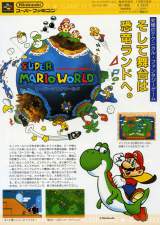
Just when you thought that Bowser and his Koopalings have already learned their lesson about messing with the Mario Brothers, they are already at it again. The only difference is that Bowser is currently wreaking havoc in the Dinosaur World. Now it's up to Mario and Luigi to rescue Princess Toadstool, save Dinosaur World and hopefully put Bowser and his Koopalings in their place.
The gameplay action is sidescrolling as in previous Mario games and it takes advantage of the SUPER FAMICOM's 16-bit graphics and stereo audio. The game consists of a journey through levels in seven worlds: Yoshi's Island, Donut Plains, Vanilla Dome, Twin Bridges Area, Forest of Illusion, Chocolate Island, and the Valley of Bowser. There are also two secret worlds--Star World and Special World (accessed via the Star World)--which can be found by completing secondary goals in specific levels.
SMW contains a map screen on which the player moves, expanding this concept which was introduced in Super Mario Bros. 3. It features 72 courses laid out across the seven worlds, and 96 exits (some levels have more than one exit). Secret exits open up new routes on the overworld map, often leading to secret levels. If you get all 96 exits you can play in a slightly different world.
The Yoshis appear in 4 different colors (green, yellow, red, and blue), each with slightly different abilities. There are also Baby Yoshis in the Star World levels which can be picked up by Mario. After eating five enemies, three berries, a Super Mushroom, Fire Flower, Starman, or Cape Feather, they will become a fully grown Yoshi of the same color.
![Goodies for Super Mario World - Super Mario Bros. 4 [Model SHVC-MW]](images/covermini160/62366_1.jpg)
CART ID: SHVC-MW
CART size: 4Mb.
Super Mario World was released on November 21, 1990 in Japan for 8,000 Yen. Also released as a Nintendo Power edition (same game ID) on September 30, 1997.
The development of this game took approximately 2 years, making an eventual development debut in September/October 1988.
As per Nintendo tradition, an episode of the Mario series was a launch title for a Nintendo game system (the Super Famicom in this case) and became an immense commercial success. The pack-in launch title for the Super Famicom. The game has sold over 20 million copies worldwide.
Shigeru Miyamoto had wanted Mario to have a dinosaur companion ever since Super Mario Bros., but the dinosaur couldn't fit into the limitations of the Famicom. Super Mario World marks the debut of Yoshi, Mario and Luigi's dinosaur friend.
Ranked as the 8th best game for a Nintendo console in Nintendo Power's Top 200 Games list. Ranked 7th in Official Nintendo Magazine's 100 greatest Nintendo games of all time. Won Nintendo Power's Game of the Year award in 1991. Named the fifth greatest game of all time in the final issue of Nintendo Power.
The game has often been compared to Super Mario Bros., in the sense that both games 'set the bar' for all subsequent sidescrollers released on their respective systems. Super Mario World introduced many now common concepts to action gaming, such as giving the player the ability to revisit levels to find overlooked secrets. It was one of the first games to reward the player for 'getting one-hundred percent' (finding all the secret exits in the levels, many of which lead to secret levels), an idea that has since become very popular. Super Mario World is still considered by many to be one of the greatest games ever because of it's simple, yet creative and addictive gameplay.
Export releases:
[US] Super Mario World [Model SNS-MW-USA]
[EU] Super Mario World [Model SNSP-MW-NOE]
[FR] Super Mario World [Model SNSP-MW-FAH]
 Nintendo Wii [Virtual Console] (dec.2, 2006) [Model JAAJ]
  Nintendo Wii [Virtual Console] (apr.26, 2008) [Model JAAK] Nintendo Wii U [Virtual Console] (apr.27, 2013) [Model JAAJ] Nintendo GBA (2001) "Super Mario Advance 2 - Super Mario World [Model AGB-AA2J-JPN]"