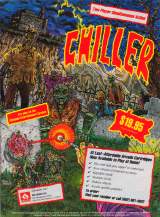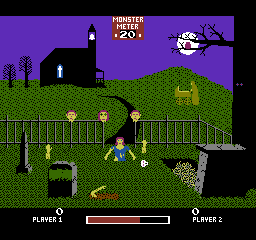
Chiller © 1990 AGCI
On a dull day in the Middle Ages, you overhear Town Elders discussing a sinister presence which has invaded the castle on the outskirts of town. Evil talismans hidden inside a castle have caused the dead to come back to life. If the spirits are not released quickly, they will mass into an army of the Undead and overtake the town! Creeping through the graveyard on your way to the castle, half-chewed arms and skulls with gnashing teeth attempt to stop you. Diabolical scenes greet you. Ever hear how a person sounds when in an iron maiden?
But then you did say you wanted adventure, didn't you?
It was the first game published by AGCI. It was not programmed in-house, it was programmed by Color Dreams.
Since American Game Cartridges Inc. was not licensed by Nintendo, they had to make their own development kit. Scott Schryver and Donald Forbes went to Target, bought several Paper Boy carts. They also bought an EPROM programmer and some 28 pin ZIF sockets from Tri-Tech. The CHR/PRG ROMs were unsoldered, and eventually replaced with the ZIF sockets. Keith fiddled with this stuff; it became the AGCI development kit. Later Donald had realized that they could probably swap the CHR ROM with a static RAM and slight circuit change. This new circuit board design was tested and later used with "Wally Bear" and Crossbow.
Forbes and Schryver managed to program several development programs. The main program at the time was CHEDIT (character edit), though later a program titled NES Paint was written. CHEDIT allowed the user to import Deluxe Paint .lbm files and then allowed editing of character tiles, character maps, and palettes. Other programs written over the time were a Shockwave maze editor, a music conversion utility, and QP. QP was Quick Pulse EPROM programmer, much faster then other EPROM programming software of the time.