

Crystal Castles © 1983 Atari.
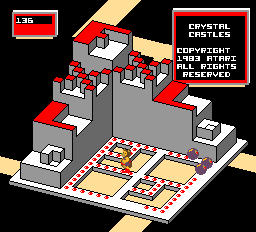
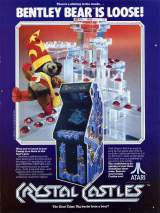
Crystal Castles is an inventive variation on the maze-driven collect-the-dots gameplay first seen in Namco's legendary Pac-Man. The player takes on the role of 'Bentley Bear', who must run around a number of castles - each presented in the form of an isometric forced 3D maze - picking up the gemstones that litter its walkways and platforms, before moving onto the next castle.
Each level is populated by a variety of enemies, including sentient trees, gem eaters, a swarm of bees and Berthilda the Witch. Some enemy types move around the levels randomly, while others will actively chase Bentley. Gem Eaters will devour any gems they reach before the player.
In addition to four-directional walking, Bentley can also jump to avoid pursuing enemies and obstacles. Many levels have platforms that can only be reached via an elevator and some screens also contain hidden secret passages and ramps, as well as 'warps' that move players forward several levels.
Jumping over the trees will shrink and temporarily disable them, while wearing Berthilda's red hat grants the player temporary invincibility, allowing them to kill the witch should they manage to catch her. If Bentley Bear touches a Gem Eater while it's in the process of eating a gem, the Gem Eater dies and 500 points are awarded to the player. However, if the Gem Eater is not eating a gem when touched, Bentley Bear dies.
Some levels contain a large pot of honey. A swarm of bees appears near the honey approximately every five seconds but collecting the honey pot earns the player 1,000 bonus points and causes the bees to appear less frequently. Other enemies, such as the balls, skeletons and ghosts must be avoided.
If Bentley collects all of the gems on a castle, the player receives bonus points. A bonus is also awarded in the event of the player picking up the last gem on the level.
Crystal Castles consists of ten different stages broken down into 37 castle mazes (with four castles making up each stage, apart from 10th, which has only one castle).
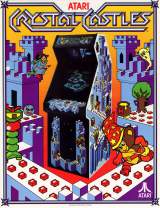
There were two different Crystal Castles cabinets, an upright and a cocktail. Both of these were highly detailed and covered with decorations. The upright cabinet had a production run of 4,880, and the cocktail cabinet had a production run of 500, for a total production run of 5,380 units.
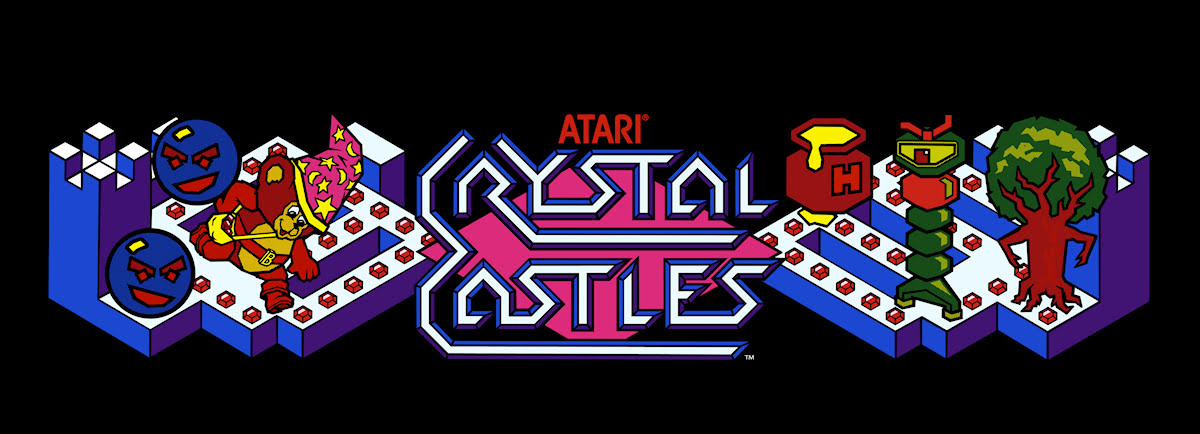
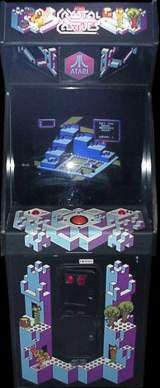
* The Crystal Castles upright was one of the best looking cabinets ever made. It is sort of colored white, and has huge painted sideart of Bentley Bear gathering gems in the castle. The marquee has a futuristic looking logo flanked with two in game scenes on a black background. There is a second mini-marquee over the speaker are that has a large Atari logo. For some reason that logo ends up going missing on many machines, and don't believe sellers when they say it is a cheap or easy part to find, because it isn't. The control panel continues the same graphical scheme as the rest of the machine. It has a standard trackball mounted centrally with fire/start buttons on either side. These trackballs eventually become worn out or damaged, and are mildly expensive to replace.
* The cocktail version has no sideart, very few cocktail machines do. But the top glass is nicely decorated and the control panel art matches the upright version. The players sit across from each other on this version, and the on screen image flips over to face whichever player is currently controlling Bentley Bear.
Game ID : 136022
Main CPU : MOS Technology M6502 (@ 1.5 Mhz)
Sound Chips : (2x) POKEY (@ 1.25 Mhz)
Players : 2
Control : trackball
Buttons : 1 (JUMP)
Crystal Castles was released in July 1983 in the USA.
When Crystal Castles first appeared in the arcades, it amazed players with its sharp graphics and pseudo 3-D mazes. The game was originally supposed to be a variation on the mega-hit Asteroids and the working title was 'Toporoids' (from TOPOgraphics and asteROIDS). It featured a one-legged robot and/or a spaceship placed in 3-D mazes lined with asteroids and the goal was (of course) to shoot them. The mazes were similar to those in Crystal Castles.
The character 'Bentley Bear' was originally named 'Braveheart Bear' in the released prototypes. But, Atari ran into trouble over that name from the American Indians and so had to change it. Whenever Bentley is killed, he shrinks, and says something in a cartoon-type balloon above his head. The four possible sayings are: OUCH; OH NO; BYE; and #?!.
Originally, FXL designed the game so that Bentley could jump while in a tunnel. But he decided to take that ability away when he saw Bentley's head popping through the roof!
The game was programmed in 6502, and Fortran was used as tool for programming.
All of the musical themes in the game are from works of classical music. The tune when you first start the game and the bonus life music, are both from The Mephisto Waltz by Liszt. The last gem bonus music is from one of the scenes in Tchaikovsky's Nutcracker Suite. And, the triumphant theme played when you complete Level 10 is of course from The 1812 Overture, again from Tchaikovsky.
If you hadn't noticed, the color schemes of the castles change during the game, and from one game to the next. The colors in the first level are always the same. From level 2 thru 6, they appear in a set order, but every 100 paid games, this set order changes. Finally, in levels 7 and up, the color scheme is picked randomly. A most odd arrangement! There are 17 possible maze color schemes, and four different color possibilities on every board: gem, floor, front wall, and side wall colors. But, each one is not randomly picked and mixed with the other; they are pre-determined as a group, and then the whole group is chosen randomly. The possible gem colors are red, blue, white, and yellow. The floor can be white, black, or pea-green. And, there are 12 possibilities for wall colors, including pink, maroon, and peach!
On two of the mazes in the game, FXL has built into the structure initials of friends of his. On Hidden Spiral, the DES stands for Desiree McCrorey, who holds a contest record on Mr. Do!. SSM is Sam Mehta, who came in 2nd in a Centipede contest held by Atari. And BBM stands for Brian McGhee, a former Atari game designer. On Berthilda's Palace, the initials are harder to make out, as they are cutouts in the floor. EDG is the initials of Eric Ginner, while MAR stands for Mark Robichek. Both of these were famous video game players at the time Crystal was made and are still known by many. Other initials appear in the game, on the above-mentioned scoreboard. While many are made up, some stand for real people. FXL appears in the top 3 spots on a new, or newly reset, game scoreboard and he also appears at other places in the top 250 initials. MEC appears more than once also. This stands for Mark Cerny, a fellow designer at Atari. He is responsible for Marble Madness.
Note : The formula for calculating the points given for the last gem bonus on a particular level and board number is 1,000 + ((((level x 4) - 1) - (4 - board)) x 100).
Frank Seay holds the official record for this game with 910,722 points.
A Crystal Castles units appears in the 1984 movie 'Gremlins'.
Michael Jackson used to own this game. It was sold at the official Michael Jackson Auction on April 24, 2009.
| Points awarded for collecting gems. | |
| Killing Gem Eaters | 500 or 1,000 points. |
| Collecting the honeypot | 1,000 points. |
| Collecting the witch's hat | 2,000 points. |
| Killing Berthilda | bonus points. |
 Atari 2600 (1984) Crystal Castles [Model CX26110]
 Atari 2600 (1984) Crystal Castles [Model CX26110P] Atari 2600 (1987) Atari 7800 : unreleased prototype Sony PlayStation (dec.31, 1997) Arcade's Greatest Hits - The Atari Collection 2 [Model SLUS-00449] Sony PlayStation (june.1998) Arcade's Greatest Hits - The Atari Collection 2 [Model SLES-00712] Sega Dreamcast (jul.2, 2001) Atari Anniversary Edition [Model T-15130N] Microsoft XBOX (nov.16, 2004) Atari Anthology [Model 26084] Sony PS2 (nov.22, 2004) Atari Anthology [Model SLUS-21076] Microsoft XBOX (nov.26, 2004) Atari Anthology Sony PS2 (feb.18, 2005) Atari Anthology [Model SLES-53061]
  Microsoft XBOX (aug.4, 2005) Atari Anthology [Model B7X-00001] Microsoft XBOX One (nov.1,2016) Atari Flashback Classics Vol.2 Sony PlayStation 4 (nov.1,2016) Atari Flashback Classics Vol.2 Nintendo DS (mar.8, 2011) Atari Greatest Hits Vol.2 [Model NTR-BR7E-USA] BBC Micro (1983) Apple II (1983) Tandy Color Computer (1984) Commodore C64 (1984) Atari ST (1986) Amstrad CPC (1986) Sinclair ZX Spectrum (1986) Atari 800 (1988) [Model RX8102] PC [MS Windows, CD-ROM] (apr.4, 1998) "Atari Arcade Hits Vol. 2" PC [MS Windows, CD-ROM] (2000) Atari Arcade Hits 2 PC [MS Windows, CD-ROM] (jul.9, 2001) Atari Anniversary Edition PC [MS Windows, CD-ROM] (dec.14, 2001) Atari Anniversary Edition PC [MS Windows, CD-ROM] (nov.11, 2003) Atari - 80 Classic Games in One! [Model 25069J] PC [MS Windows, CD-ROM] (june.10, 2005) "Atari - 80 Classic Games in One! [Replay]" Steam (mar.24,2016) "Atari Vault [Model 400020]" Nokia N-Gage (feb.2006) Atari Masterpieces Vol. II Nokia N-Gage (mar.30, 2006) Atari Masterpieces Vol. II Apple Store (2012) "Atari Greatest Hits" Google Play (2012) "Atari Greatest Hits"