

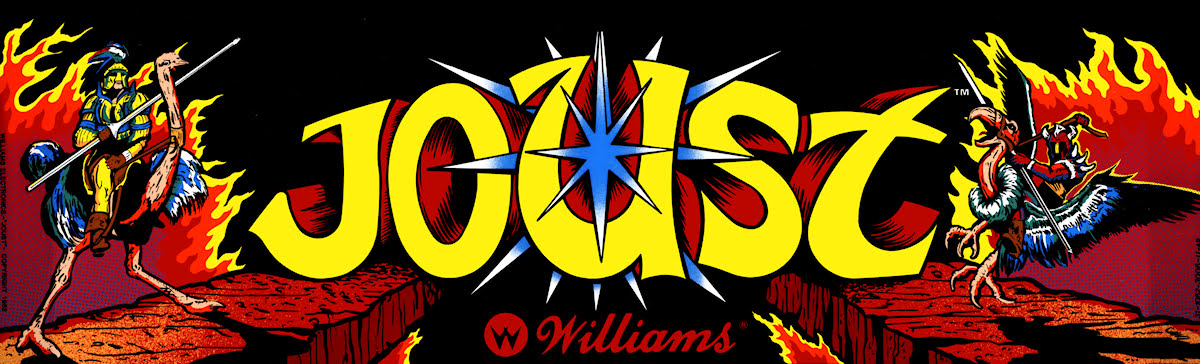
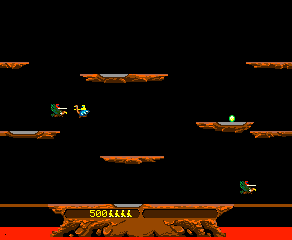
Joust © 1982 Williams.
Joust is a platform-based action combat game for one or two-players (with the two-player game offering either team-up OR head-to-head combat; the first time arcade gamers were given this choice) in which each player controls a knight riding on the back of a flying ostrich.
The object of the game is to progress through platform-based levels by defeating groups of buzzard-riding enemy knights. This is achieved by 'jousting'; both enemy and player knights carry a lance and must fly around the level (actioned by repeatedly hitting the 'Flap' button) trying to oust rival knights from their steeds by ramming them with the lance. This can only be achieved if the attacking rider is above the enemy knight when the lance connects. A collision of equal elevations results in the two knights bouncing off each other, but if a player is lower than their enemy at the instant of contact, they themselves will be knocked from their steed and lose a life.
A defeated enemy will turn into an egg that falls to the bottom of the screen. This must be quickly collected by players as if the egg lands on a platform and isn't retrieved in time, it will eventually hatch into another enemy knight that must be defeated again.
Joust features three different types of enemy knights - Bounder, Hunter, and Shadow Lord - with each earning players different points values when defeated. A pterodactyl will appear after a predetermined time to hunt the players.
Accurately navigating the player Knights can be initially quite difficult as control is strongly affected by both gravity and inertia. Players can lose a life by either being knocked from their steed by an enemy knight, or by falling into the lava pit at the bottom of each level.
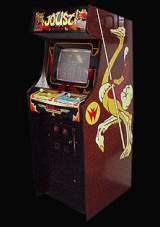
* The upright version of Joust was a dedicated cabinet. It is similar in shape to other Williams games from that era, but it is not identical to them. The cabinet is largely black with no painted art on the front of the machine. But it does have sideart, in this case a four-color painted rendering of a knight riding a large bird, while carrying a lance. This design is fairly simple when compared to the sideart on other games, and can be repainted by hand, as long as you are careful. The control panel, monitor bezel, and marquee are all filled with the expected graphics. The marquee especially is a stunning rendition of the Joust logo, and two riders inside the Joust world. Your Joust machine will come with either 2-way leaf switch joysticks, or 2-way optical ones. The early cabinets had the optical ones, while the later ones used the leaf stick ones.
* The cocktail version (a cocktail game is a sit down table version), is notable because it was one of the most popular cocktail cabinets for conversion to newer titles. You see most cocktail tables originally held games that had monitors in a vertical orientation, and had a set of player controls on each end of the table. By 1985 no one was really making many vertical games, especially not ones that were one player at a time, and could flip the screen for the second player. But the Joust table was different. It had a horizontal monitor, and the players sat side by side, instead of at opposite ends of the table. This allowed the Joust cocktail cabinet to be used for all sorts of newer games. Electronically the cocktail version of Joust was identical to the upright version. The cocktail cabinet did not feature a lot of art, and was mostly black.
The Joust PCBs are functionally identical to those used in "Defender", "Robotron - 2084", "Bubbles", "Sinistar", and "Stargate", only the ROM chips are different.
Main CPU : Motorola M6809 (@ 1 Mhz)
Sound CPU : M6808 (@ 894.75 Khz)
Sound Chips : DAC
Players : 2
Control : 2-way joystick (LEFT and RIGHT)
Buttons : 1 (FLAP)
Joust was released in September 1982 in the USA.
The name of this game is a reference for 'Jousting'. Jousting is a competition between two knights on horse-back, wherein each knight tries to knock the other off his mount. Jousting was popular in medieval times.
Joust shares some sounds from Defender and Stargate.
James Vollandt holds the official record for this game on 'Marathon' settings with 107,216,700 points.
Don Morlan holds the official record for this game on 'Tournament' settings with 1,002,500 points.
A Joust unit appears in the 1983 movie 'Joysticks'.
A Joust unit appears (multiple times) in a 'Columbo' tv movie episode : (Murder, Smoke and Shadows) directed by James Frawley.
| Killing enemies | |
| Bounder (Red) | 500 points. |
| Hunter (Silver/Gray) | 750 points. |
| Shadow Lord (Blue) | 1,000 points. |
| Pterodactyl | 1,000 points. |
| Getting killed | 50 points. |
| Picking up eggs or hatchlings | 250, 500, 750, or 1,000 points (progressive). The progression starts again when the player is killed or starts the next wave. |
| Picking up an egg before it touches the ground | 500 points. |
| Not dying during a Survival Wave | 3,000 points. |
| If neither player kills the other during a Team Wave (2-player game only) | 3,000 points for each player. |
| The first player who kills the other player during a Gladiator Wave (2-player game only) | 3,000 points. |

 Atari 2600 (1983) Joust [Model CX2691] Colecovision : Unreleased prototype Atari 5200 (1983) Joust [Model CX5240] Atari 7800 (1986) Joust [Model CX7806] Nintendo Famicom (oct.30, 1987) Joust [Model HAL-JU] Nintendo NES (oct.1988) Joust [Model NES-JU-USA] Sega Genesis (1996) Williams Arcade's Greatest Hits
  Sega Mega Drive (1996) Arcade's Greatest Hits [Model T-97126-50] Sega Saturn (1996) Arcade's Greatest Hits [Model T-9703H] Sony PlayStation (apr.10, 1996) Williams Arcade's Greatest Hits [Model SLUS-00201] Sony PlayStation (sept.1, 1996) Williams Arcade's Greatest Hits [Model SLES-00323] Nintendo SNES (oct.1996) Williams Arcade's Greatest Hits [Model SNS-AW8E-USA] Nintendo SNES (jan.8, 1997) Williams Arcade's Greatest Hits [Model SNSP-AW8P-EUR] Sega Dreamcast (june.27, 2000) Midway's Greatest Arcade Hits Vol. 1 [Model T-9713N] Sega Dreamcast (jul.28, 2000) Midway's Greatest Arcade Hits Vol. 1 [Model T-9710D-50] Nintendo 64 (nov.14, 2000) Midway's Greatest Arcade Hits Vol. 1 [Model NUS-NAIE-USA] Sony PS2 (nov.18, 2003) Midway Arcade Treasures [Model SLUS-20801] Microsoft XBOX (nov.24, 2003) Midway Arcade Treasures Nintendo GameCube (dec.18, 2003) Midway Arcade Treasures [Model DOL-GAKE-USA] Microsoft XBOX (feb.6, 2004) Midway Arcade Treasures Sony PS2 (feb.6, 2004) Midway Arcade Treasures [Model SLES-51927] Microsoft XBOX 360 [XBLA] (nov.22, 2005) : retired in 2010 Microsoft XBOX 360 [XBLA] (dec.2, 2005) : retired in 2010 Microsoft XBOX 360 [XBLA] (dec.10, 2005) : retired in 2010 Sony Playstation 3 [PSN] (may.24, 2007) Sony Playstation 3 [PSN] (june.15, 2007) Microsoft XBOX 360 (nov.6, 2012) Midway Arcade Origins Sony PlayStation 3 (nov.6, 2012) Midway Arcade Origins [Model BLUS-31083] Microsoft XBOX 360 (nov.15, 2012) Midway Arcade Origins Sony PlayStation 3 (nov.15, 2012) Midway Arcade Origins [Model BLES-01768] Atari Lynx (1992) Joust [Model PT5005] Nintendo Game Boy (1995) "Arcade Classic No. 4 - Defender & Joust [Model DMG-ADJP-UKV]" Nintendo Game Boy (oct.1995) "Arcade Classic No. 4 - Defender & Joust [Model DMG-ADJE-USA]" Nintendo Game Boy Color (mar.1999) "Arcade Hits - Joust & Defender [Model DMG-AADE-USA]" Nintendo Game Boy Color (apr.1999) "Arcade Hits - Joust & Defender [Model DMG-AADP-EUR]" Nintendo GBA (nov.22, 2001) Midway's Greatest Arcade Hits [Model AGB-AM3E-USA] Nintendo GBA (nov.30, 2001) Midway's Greatest Arcade Hits [Model AGB-AM3P-EUR] Sony PSP (dec.13, 2005) Midway Arcade Treasures Extended Play [Model ULUS-10059] Sony PSP (feb.24, 2006) Midway Arcade Treasures Extended Play [Model ULES-00180] PC [Booter] (1983) Atari 800 (1983) Joust [Model RX8044] Commodore C64 (1984) Jouste Atari ST (1986) Amstrad CPC (1986) Apple MacIntosh (1994) PC [MS Windows 3.1/DOS, CD-ROM] (1995) Williams Arcade Classics PC [MS Windows 95/DOS, CD-ROM] (1996) Williams Arcade Classics PC [MS Windows, CD-ROM] (aug.27, 2004) Midway Arcade Treasures PC [MS Windows, CD-ROM] (nov.23, 2004) Midway Arcade Treasures Palm OS (aug.2001) "Midway Arcade Classic" Tiger Game.com (1997) "Williams Arcade Classics [Model 71-722]" Mobile Phones (nov.1, 2004) Apple iPhone/iPod (feb.23, 2012) "Midway Arcade [Model 476467441]"