
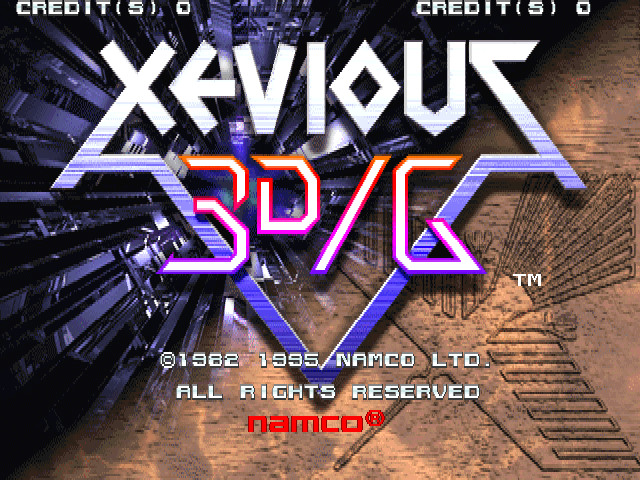
Xevious 3D/G © 1996 Namco.
An excellent sequel in 3-D.
You are the pilot of the mighty combat aircraft 'Solvalou' and must fly through vast zones full of enemies and armed with the classic weaponry the forward-firing gun for aerial targets, and the bombs to destroying ground-based targets and with the addition of a series of new and powerful weapons.
This game is a very popular sequel to the "Xevious" saga. It became quite popular because of a good 3-D modelling and nice camera work and featuring a nice BGM and sounds.
Namco System 11 hardware
Game ID : XV3
Main CPU : PSX (@ 16.9344 Mhz), M37702 (@ 16.384 Mhz)
Sound Chips : C352 (@ 16.384 Mhz)
Players: 2
Control: 8-way joystick
Buttons: 2
Even if the title screen says 1995, Xevious 3D/G was released in April 1996 in Japan. Its only appearance outside of Japan was on the Sony PlayStation (see Ports below).
Just as in the original "Xevious", there are hidden Sol Citadels and Special Flags.
* Revision 1 :
XV31/VER.A : Japan release, 13:03:46, APR 10 1996
Secret message : at the very beginning of the game, you have to cross a river. If you drop bombs at the edge of this you will get the secret message : "NAMCO ORIGINAL CREATED BY K.KENJO" .
1. Xevious (1982, Arcade)
2. Super Xevious (1984, Arcade)
3. Super Xevious - Gump no Nazo [Model SX-4900] (1986, Arcade)
4. Xevious - Fardraut Saga (1988, MSX2)
4. Solvalou (1991, Arcade)
5. Xevious 3D/G (1995, Arcade)
6. Xevious Arrangement (1995, Arcade): part of "Namco Classics Collection Vol.1"
7. Xevious Resurrection (2010, PS3/PSN): part of "Namco Museum.com"
Director : Kohji Kenjoh
Visual director : Rascal Fukuda
Proto programmer : Yousuke Kuroda
Coordinator : Yutaka Kounoe, Tadashi Iguchi
Programmers : Hajime Harima, MT-Kio
Visual designers : Kaname Takai, Nabuo Takahashi, Muneyuki Tejima
Test mode programmers : Kazuyuki Nikaido
Graphic designer : Hideaki Ito
Music & Sound effects : Ayako Saso (Aya), Shinji Hosoe (Megaten), Nobuyoshi Sano (sanodg), Hiroto Sasaki (Saman)
Debug & Tuning team : Kazuo Takahashi, Tetsuya Akatsuka, Norikatsu Yoshikawa, Jin Okubo, Yasumichi Onishi, Satoshi Masukawa
Supervisor : Shukuo Ishikawa, Hajime Nakatani, Katsuo Nakamura, Junichi Kawamura, Masaya Nakamura
CONSOLES:
 Sony PlayStation (mar.28, 1997) "Xevious 3D/G+ [Model SLPS-00750]"
 Sony PlayStation (june.30, 1997) "Xevious 3D/G+ [Model SLUS-00461]"
 Sony PlayStation (aug.1997) "Xevious 3D/G+ [Model SCES-00736]"
Game's ROM.
Game's screenshots.
Official website: http://www.bandainamcogames.co.jp/am/vg/xevious3d/
 Info
Info Music (23)
 Video (2)
 Doc (1)
 ROM
ROM DIP Switch
 Edit
Edit Upload
 Add
Add