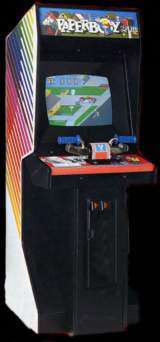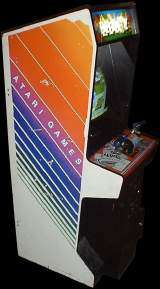
Paperboy © 1985 Atari Games.
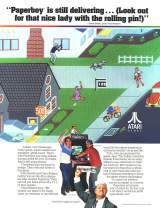
Paperboy is a one or two-player game in which the objective is to deliver Newspapers to the Paperboy's customers from Monday through to Sunday.
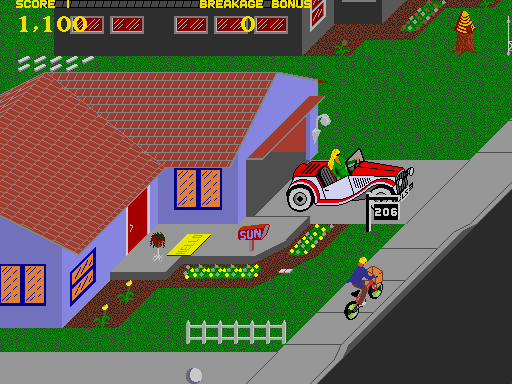
Each game begins with ten customers and ten non-customers. Paperboy's customers live in the brightly coloured houses, while non-customers live in dark coloured houses. To deliver to a customer, the player must throw a paper either into the customer's mailbox, or onto their front porch. Failure to deliver a paper to a customer results in the loss of that customer for the next day. Any damage done to a customer's property also results in the loss of that customer. Losing all ten of Paperboy's customers will get him fired and the game is over. However, on any day in which all customers have their papers successfully delivered, one of the non-customers will re-subscribe.
Non-customers' houses and yards are loaded with targets at which to throw your extra papers (windows, lamps, statues, etc.). Hitting these targets earns points for the "Breakage Bonus", which is displayed at the top center of the screen. The total Breakage Bonus is awarded to the player at the end of each day (or at the end of the game-whichever comes first).
If Paperboy loses a customer, that customer's house will be dark coloured the next day. As a non-subscriber, this house now presents more targets at which to throw newspapers for building up the Breakage Bonus. At the start of each day, a map of Paperboy's route is displayed to indicate subscriber and non-subscriber houses. This helps to remind players of what customers they may have lost on the previous day and the location of remaining customers.
Paperboy can carry a maximum of ten papers at a time, but can restock his supply by riding over paper bundles placed here and there on his route. A paper supply indicator is displayed underneath the player's score.
While making his deliveries, Paperboy must avoid collisions with all stationary objects and other characters moving about the neighborhood. To avoid collisions, Paperboy can ride his bike anywhere - on the sidewalk, in the street, or into front yards. A collision with anything results in the loss of a life.
In addition to the obstacles, non-subscribers are hostile towards Paperboy and will attack him and try to knock him down. If Paperboy damages a subscriber's property, that character may also attack. So the more customers that are lost, the more hostile the neighborhood becomes toward Paperboy.
At the end of each delivery day, players have a chance to sharpen their skills by guiding Paperboy through the Paperboy Training Grounds. This obstacle course is filled with various targets at which to throw newspaper, as well as ramp jumps to be negotiated. This is a bonus round and no lives are lost for failing to reach the finish line.
Game ID : 136034
Runs on the "Atari System 2" hardware.
Players: 2
Control: Bicycle handlebars
Buttons: 2 (one on each side of the handlebars, for throwing papers)
Even if the title screen says 1984, Paperboy was released in April 1985.
3,442 units were produced. The selling price was $2,495.
On Monday, June 30, 1986; Mr. Mark Caesar and Mr. Robin Hallingstad filed a suit against Atari Games Corp. for $1 million plus profits alleging that the company stole the idea for a video game that was marketed by the name of PAPERBOY. The boys had submitted to Atari a detailed proposal for a similar game in July 1983.
After a score of 10,000,000 or more is achieved, the initial in the top 10 ranking merges with the score to produce a truly impressive score display. For example, if you had top score at 10,000,000, this would appear as '110000000'.
The default high score screen of "Cyberball 2072" features names of many Atari arcade games, including PAPERBOY.
Phil Britt holds the official record for this game ('Grand Slam' score of all three streets combined) with 1,136,435 points.
The main character appears on the 2012 animation movie "Wreck-It Ralph" from Walt Disney Animation Studios.
1) Be careful not to move too slowly - swarms of bees or nasty whirlwinds may come to push you along.
2) Develop skill in maneuvering in and out of tight situations using the handlebar control.
3) Build up your Breakage Bonus by riding over flowers in non-subscribers' yards.
4) Some players prefer to lose many of their customers so they can do more 'trashing'. Others like to try for Perfect Deliveries. See which strategy scores highest for you.
5) Try hitting characters with papers - you might be pleased with the results!
6) Dirt piles in the streets can be used for making jumps, which will also score points
1. Paperboy (1984)
2. Paperboy II (1992, Sega Genesis)
3. Paperboy (1999, Nintendo 64)
Programmer : John Salwitz
Artist : Dave Ralston
Hardware Designer : Doug Snyder
Project Coordinator : Russell Dawe (Rusty Dawe)
Technician : Linda Sinkovic
Sound Designers : Hal Canon, Earl Vickers
Mechanical Engineer : Milt Loper
Animator : Will Noble
CONSOLES:
 Atari 7800 : Unreleased prototype
Nintendo NES (dec.1988) "Paperboy [Model NES-PY]"
 Sega Master System (1990) "Paperboy [Model 5008]"
Sega Master System (1990) "Paperboy [Model 5121]"
Nintendo NES (oct.26, 1990)
Sega Genesis (1991)
Sega Mega Drive (1991)
 Nintendo Famicom (jan.30, 1991) "Paperboy [Model ALT-7B]"
Sega Mega Drive (june.26, 1992) "Paperboy [Model T-48043]"
 Sega Master System (1992) : by Tec Toy
Sony PlayStation "Paperboy [Model SLUS-00848]" : Unreleased
Sony PlayStation (dec.31, 1997) "Arcade's Greatest Hits - The Atari Collection 2 [Model SLUS-00449]"
Sony PlayStation (june.1998) "Arcade's Greatest Hits - The Atari Collection 2 [Model SLES-00712]"
Nintendo 64 (oct.31, 1999) "Paperboy [Model NUS-NYPE-USA]"
Nintendo 64 (mar.2000) "Paperboy [Model NUS-NYPP-EUR]"
Sega Dreamcast (nov.15, 2001) "Midway's Greatest Arcade Hits Vol. 2 [Model T-9714N]"
Sony PS2 (nov.18, 2003) "Midway Arcade Treasures [Model SLUS-20801]"
Microsoft XBOX (nov.24, 2003) "Midway Arcade Treasures"
Nintendo GameCube (dec.18, 2003) "Midway Arcade Treasures [Model DOL-GAKE-USA]"
Microsoft XBOX (feb.6, 2004) "Midway Arcade Treasures"
Sony PS2 (feb.6, 2004) "Midway Arcade Treasures [Model SLES-51927]"
Microsoft XBOX 360 [XBLA] (feb.14, 2007): Retired in 2010.
HANDHELDS:
Atari Lynx (1990) "Paperboy [Model PA2041]"
Nintendo Game Boy (1990) "Paperboy [Model DMG-MP-EUR]"
 Nintendo Game Boy (1990) "Paperboy [Model DMG-MP-UKV]"
Nintendo Game Boy (jul.1990) "Paperboy [Model DMG-MP-USA]"
Sega Game Gear (1992)
Nintendo Game Boy Color (1999) "Paperboy [Model CGB-AYPP-EUR]"
Nintendo Game Boy Color (1999) "Paperboy [Model CGB-AYPE-USA]"
Nintendo GBA (aug.21, 2005) "2 Games in One! Paperboy + Rampage [Model AGB-B6BE-USA]"
Nintendo GBA (sept.16, 2005) "2 Games in One! Paperboy + Rampage [Model AGB-B6BP]"
Sony PSP (dec.13, 2005) "Midway Arcade Treasures Extended Play [Model ULUS-10059]"
Sony PSP (feb.24, 2006) "Midway Arcade Treasures Extended Play [Model ULES-00180]"
COMPUTERS:
BBC Micro (1984)
Tandy Color Computer (1985) "Paper Route"
Commodore 16 (1986)
Sinclair ZX Spectrum (1986)
Commodore C64 (1986)
Amstrad CPC (1986) : by Elite Systems
PC [MS-DOS, 5.25"] (1988)
Apple IIGS (1988)
Atari ST (1988)
Amstrad CPC (1989) "12 Top Amstrad Hits"
Commodore Amiga (1989)
PC [MS Windows, CD-ROM] (jan.1, 1999) "Arcade's Greatest Hits - The Atari Collection 2"
PC [MS Windows, CD-ROM] (aug.27, 2004) "Midway Arcade Treasures"
PC [MS Windows, CD-ROM] (nov.23, 2004) "Midway Arcade Treasures"
OTHERS:
Tiger Handheld LCD Game (1988)
Mobile Phones (june.11, 2006)
BlackBerry (nov.30, 2009) "Paperboy [Model 4704]"
Apple iPhone/iPod (dec.18, 2009) "Paperboy [Model 339779244]"
Apple iPhone/iPod (jan.27, 2010) "Paperboy ES [Model 351632756]"
Apple iPhone/iPod (feb.3, 2010) "Paperboy Classic [Model 345105800]"
Apple iPhone/iPod (nov.4, 2010) "Paperboy: Special Delivery [Model 388964792]"
Game's ROM.
Game's picture.
 Info
Info Goodies (5)
 Video (1)
 Doc (1)
 ROM
ROM DIP Switch
 Edit
Edit Upload
 Add
Add