

![Tron [Model 628] screenshot](images/game/2979_1.png "Tron [Model 628]")
Tron © 1982 Bally Midway.
Tron is a 1- or 2-player game set inside the 'Tron' computer, and is based on the ground-breaking Disney movie of the same name.
Tron consists of twenty-two stages - or 'phases' - of play. Each phase consists of four separate games called "domains", all of which must be completed before moving on to the next phase. Players can determine the order in which each of the four domains is attempted, but the domain position is random and is only revealed once that domain has been chosen.
The four domains that make up a phase never change throughout the game, although both the difficulty level and number of enemies increases with each subsequent phase. The domains are as follows:
* LIGHT CYCLES : The player controls a Light Cycle that leaves a blue light trail in its wake. The aim is to 'box in' the yellow enemy Light Cycles, making them crash into either a cycle trail (theirs or the player's) or a wall. The player must also avoid any collision with either walls or light trails. The joystick controls the direction of the bike and the trigger controls its speed.
* I/O TOWER : Destroy the Grid Bugs that emerge from the grid surrounding the tower. The bugs will multiply and fill the entire screen if not stopped. Players must attempt to clear a path to - and enter - the I/O Tower before the timer runs out. The stick controls the movement of the player's character and the spinner controls the direction of fire.
* TANK MAZE : Destroy all enemy tanks that are patrolling the maze. The player's tank can fire in all directions and can bounce shots off walls, but can be destroyed by a single shot; while enemy tanks can only fire in the direction of travel but need three shots before they are destroyed. "Recognizer" tanks also feature in later phases; these Do NOT shoot but move quickly and will try to ram the player's tank. The joystick controls the movement of the player's tank and the spinner controls the direction of fire.
* MCP CONE : Destroy the blocks in the descending, rotating coloured column to clear a path and move the character up into the light cone above the blocks. A bonus is awarded if all of the blocks are destroyed. The stick controls the movement of the character and the spinner controls the direction of fire.
Bonus lives are awarded periodically throughout the game as specific point scores are reached. Each enemy and item has an assigned point value (see the SCORING section for details).
![Goodies for Tron [Model 628]](images/covermini160/2979_1.jpg)
[Game No. 628]
[Upright model]
Bally Midway MCR 2 hardware
Main CPU : Zilog Z80 (@ 2.496 Mhz)
Sound CPU : Zilog Z80 (@ 2 Mhz)
Sound Chips : (2x) General Instrument AY8910 (@ 2 Mhz)
Players : 2
Control : 8-way 'flight yolk' controller with a trigger, spinner knob
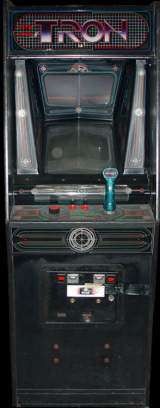
Tron was released in May 1982.
When Bally/Midway signed a deal to create a Tron video game, they were very pressed for time and needed a game quickly. They decided to let all 3 of their design teams (their in-house team, Dave Nutting Associates, and Arcade Engineering) take a crack at a prototype. The Dave Nutting Associates team (led by Dave Armstrong) proposed a 3-D color vector game that was deemed too complex and expensive, thought it was later developed into a prototype called "Earth, Friend, Mission". The internal team eventually won the right to produce the game. The initial design document called for 6 different mini-games :
1) Rings (a light-disk duel between Tron and Sark).
2) Paranoia (in which the player builds a bridge of spiders to reach an island).
3) Tank Pursuit
4) Space Spores
5) I/O Tower (the player tries to reach an energy socket while avoiding electrifying blue warriors)
6) Light Cycles.
Fearing that they would never get the game out in time, the Rings game was made into a separate game and the Paranoia and I/O Tower game was dropped (though the MCP Cone sequence was later added). At one point the film included deadly spores that were included in the game's Grid Bug sequence, but when they were removed from the movie, they had to be removed from the game as well.
To promote the game, Bally/Midway and Alladin's Castle sponsored a seven-week-long tournament at over 400 locations throughout the country, as well as a celebrity tournament.
Most of the levels correspond to a computer language. Of course, some literary license was used for the level names and a couple of them don't really make sense. Anyway, here are the 11 level names and what they are :
ALGOL : Algorithmic Language. Influenced the development of more modern language (along with FORTRAN and LISP). Used for number crunching.
ASSEMBLY : Machine language. Used to write code directly to the computer without having to compile or interpret it.
BASIC : Beginners All-purpose Symbolic Instruction Code. Used primarily for teaching rudimentary programming.
COBOL : Common Business Oriented Language. Used primarily for accounting. Very old language.
FORTRAN : Formula Translator. Used for processing numbers and/or formulas.
JCL : Job Control Language. Used on IBM mainframes to execute specific jobs and scripts on the Job Entry Subsystem.
OS : Precursor language to OS2.
PASCAL : Teaching language for compiled languages. Not very powerful.
PL1 : A play on the actual language called PLI. Language used for solving mathematical problems.
RPG : Report Program Generator. Use for generating reports. Usually used with COBOL.
SNOBOL : Used for character string manipulation.
Walt Disney Productions sued Williams Electronics for copyright and patent infringement over Williams' use of the name 'tron' in their arcade legend, "Robotron - 2084". Common sense prevailed, however, and Williams won the suit.
The game's sequel, Discs of Tron was originally intended to be a part of the original game but tight time constraints meant that the mini-game was not completed in time.
A Tron unit appears in the 1983 movie, 'War Games', in the 1986 movie 'The Color of Money' and in the 1987 movie, 'Death Wish 4 - The Crackdown'.
| Scoring in this game is relatively easy since there aren't a lot of enemies to keep track of. | |
| Grid Bugs | 50 points |
| Bit | 5000 points |
| Blocks | 25 points |
| Light Cycles | 500 points |
| Tanks... | |
| 1st Hit | 100 points |
| 2nd Hit | 300 points |
| 3rd Hit | 500 points |
| You get a 1000 point bonus for destroying all the Grid Bugs. | |
| You get the remaining time added to your score when you enter the I/O Tower. | |
| NOTE | On Level 1 (RPG), you only get 500 on the timer. On all other levels, you get 1000 on the timer. EXCEPTION : As stated in the "Updates" section above, if you're playing the (6/15) version, you always get 1000 on the timer, even on Level 1. |
| You get a 1000 point bonus for destroying all the Blocks. | |
 DynaVision (198?) Tron

 Microsoft XBOX 360 [XBLA] (jan.9, 2008) Tandy Color Computer (1983) "Kron" Oric I (1984) Light Cycle Sinclair ZX Spectrum (1984) Light Cycle