

![Street Fighter Zero [Green Board] screenshot](images/game/2669_1.png "Street Fighter Zero [Green Board]")
Street Fighter Zero © 1995 Capcom Co, Limited.
The new look of the Street Fighter series, with ten characters including old favorites and new surprises.
![Goodies for Street Fighter Zero [Green Board]](images/covermini160/2669_1.jpg)
Runs on the "CP System II" hardware.
Green Board [Japan]
Players: Up to 2.
Control: 8-way joystick per player.
Buttons: 6 per player.
= > [1] LP, [2] MP, [3] HP
= > [4] LK, [5] MK, [6] HK
Street Fighter Zero was released on June 5, 1995 (Monday) in the Japanese arcades. It was known there as the 11th video game released for the CPS2 hardware.
Known Export releases:
Street Fighter Alpha - Warriors' Dreams [Blue Board]
Street Fighter Zero [Grey Board]
Street Fighter Zero [Orange Board]
Street Fighter Zero [Pink Board]
The Zero series of games take place between the original Street Fighter and Street Fighter II. The scar on Sagat's chest in SFII is said to be from Ryu's Shouryuuken during the final battle in the original Street Fighter. In SF Zero, Sagat has the scar on his chest, so it must take place after the first Street Fighter. The character Nash was mentioned in Guile's ending in SFII. He is a friend of Guile who was killed by Vega. Since Nash is still alive in the Zero series, it must take place before SFII.
This is the first Street Fighter game to have the Dramatic Battle Mode, a feature no doubt inspired by the Japanese animated movie, 'Street Fighter II', where Ken and Ryu team up to fight M. Bison in the final battle.
This game marks the first time Gouki's name is displayed on-screen in the game.
Ryu / Guy stages :
The Son Son convenience store in Ryu and Guy's stages is named after an earlier Capcom game of the same name.
A poster for the animated feature film version of Street Fighter II can be seen on display.
The kanji on the small sign on the bath-house means 'Honda Bath'.
The curtain on the bath-house (in Guy's version of the stage) says 'yu' in hiragana, which is the reading for the 'bath' kanji on the 'Honda Bath' sign.
In "Street Fighter Zero 3", Edmond Honda's stage is in front of this (or a similar-looking) bath-house with slightly different signs on it.
In Street Fighter II - The World Warrior (and all its follow-ups), Honda's stage is inside of a bath house.
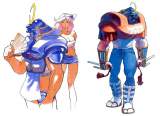
Guy and Sodom are from Capcom's Final Fight - Guy as selectable character and Sodom as the second boss in Final Fight. Guy's music is taken from Final Fight.
Sodom is a westerner who is obsessed with Japanese culture and apparently doesn't speak Japanese very well. In the Japanese versions of these games, Sodom's victory quotes are meaningless sentences composed of English words (e.g., 'SHOW BY HUNG JAW') followed by a Japanese translation of what he actually meant to say. In Sodom's ending, he claims about reforming and renaming the Mad Gear gang into something with four kanji. Those kanji read 'Ma-do-gi-a'. Now this could just be random kanji that, when strung together, sound like 'Mad Gear', but by the same token, it can sound like 'Mad Doggie'. The jitte weapons Sodom uses were used by policemen in feudal Japan.
Change of Race: In the original Street Fighter, Birdie looked Caucasian. In SF Alpha, Birdie is black. The reason for this change is explained in one of Birdie's "Street Fighter Zero 3" win quotes (he was sick at the time of the first Street Fighter).
Sony Music Entertainment released a limited-edition soundtrack album for this game (Street Fighter Zero Arcade Game Track - SRCL-3297) on August 21, 1995.
 Sony PlayStation (dec.22, 1995) Street Fighter Zero [Model SLPS-00176] Sega Saturn (jan.26, 1996) Street Fighter Zero [Model T-1206G] Sony PS2 (may.25, 2006) "Street Fighter Zero - Fighters Generation [Model SLPS-66409]" (mar.30, 2001) Street Fighter Alpha - Warriors' Dreams [Model CGB-BFZJ-JPN] (1997) : Bundled with Street Fighter Zero 2 (1995)