

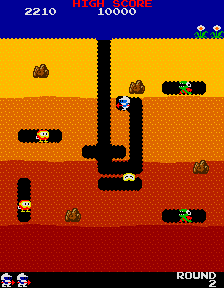
Dig Dug © 1982 Namco.
Dig Dug is single screen action game in which the player must dig horizontal and vertical tunnels to reach and eliminate the underground-dwelling monsters living there. This is achieved by either inflating them with an air pump until they explode, or by dropping rocks onto them.
There are two kinds of enemies in the game; 'Pookas' (a race of round, red monsters) and 'Fygars' (a race of green, fire-breathing dragons). Monsters are initially trapped in caves and can escape in one of two ways: Dig Dug can dig them out, after which they will immediately start chasing the player, but after the set time monsters can also escape a cave by turning into ghosts. In this form they can't be killed are aren't restricted to using tunnels to move around. They can float through solid dirt and travel diagonally but once a ghost enters a tunnel, it can be killed.
The monsters move faster than Dig Dug in vertical tunnels and slower on the surface. They will kill Dig Dug on contact and 'Fygar' can also kill Dig Dug by breathing fire on him. Fygar can only breathe fire horizontally but his flames can penetrate solid dirt. A partially inflated monster will gradually deflate and recover after a few seconds but while deflating, Dig Dug can pass safely through it.
The deeper underground an enemy is when it's killed, the more points are awarded. Each screen has four depth levels and these are darker in colour the further underground they are. Additionally, Fygars are worth double points if exploded horizontally rather than vertically (since they can only breathe fire horizontally and therefore present a greater threat).
Extra points are awarded for dropping rocks onto enemies rather than inflating them and after the player has dropped two rocks, a bonus item appears at the center of the screen, awarding points if the player collects it before it disappears. The two rocks only have to be dropped, the bonus item will appear irrespective of whether or not the rocks killed an enemy. These bonus items consist of various fruit and vegetables, as well as the flagship from the Namco game Galaxian.
The last enemy in a round will try to escape via the top left of the screen and if he succeeds, potential points are lost. The round numbers are represented by flowers at the top-right of the screen. After every fourth round, the colour of the dirt will change. Successive rounds feature an increasing number of monsters that also move at a faster speed.
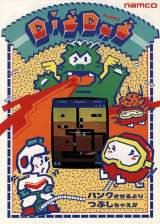
Main CPU : Zilog Z80 (@ 3.072 Mhz)
Sub CPU : Zilog Z80 (@ 3.072 Mhz)
Sound CPU : Zilog Z80 (@ 3.072 Mhz)
Sound Chips : Namco 3-channel WSG
Players : 2
Control : 4-way joystick
Buttons : 1 (PUMP)
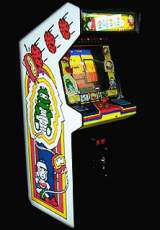
Dig Dug was released on April 19, 1982 in Japan.
Dig Dug was a shining addition to the golden age of video games. The game's charming world and innovative game play made it an instant classic.
The main character of Dig Dug has a name in Japan, 'Taizo Hori', a pun based on the phrase 'Horitai zo', or 'I want to dig!'. He is believed to be the father of Mr. Driller. He makes an appearance on the 2012 animation movie 'Wreck-It Ralph' from Walt Disney Animation Studios.
* A place in video game history : "During the golden age of video games we saw a lot of novel approaches to gaming," said Chris Lindsey, director of the National Video Game and Coin-Op Museum in St. Louis. "'Tempest', for instance, required things of its players that we'd never seen in a video game before. You had to learn a whole new set of skills to further the game experience. Dig Dug is another game that provided a novel approach. The types of movement you had to learn, the skills you had to develop, were like none other up until that point. And this game play was combined with a really engaging subject matter, which was this guy, Dig Dug, who digs around underground after subterranean monsters, and who explodes them with a really bizarre weapon, an air pump! There was just this string of interesting, engaging things for the viewer to look at and experience while dealing with this new type of game. It really captured, and still captures, the imagination. The sounds in Dig Dug are also really distinctive. When people hear that music start to play here at the museum, they'll laugh with recognition. It's quite funny watching people play that game."
* The great 25-cent escape : Lindsey enjoys seeing visitors to his museum discover a video game that rekindles memories from earlier years.
"They'll say, 'Wow, I used to be great at this!' And then they'll adopt their old game-playing position -- which seems to vary almost randomly from person to person, " Lindsey said. "They drop a token in, start rolling, and then they will lose all sense of time and space, becoming completely immersed in the game. Often they'll start laughing. I had a guy yesterday who was so funny. He came in and had obviously played these video games quite a bit in years past, like many of us did. He wandered around the museum, going from game to game, and he just laughed hysterically as he remembered all the little details of each game that he had spent so much time on, so long ago."
* Namco notes that after the release of Dig Dug in 1982, Namco engineers went to arcades to watch their new game being played. They noticed that "there were two completely separate groups of people. One group enjoyed blowing the enemy up with the pump. The other group enjoyed beating the enemy by dropping rocks on them".
Donald Hayes holds the official record for this game with 5,142,500 points on March 24, 2011.
A bootleg of this game is known as Zig Zag. Another bootleg running on the Galaxian hardware was made by LAX as Zigzag.
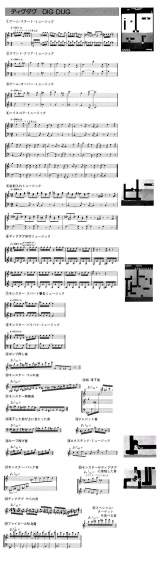
Alfa Records released a limited-edition soundtrack album for this game (Video Game Music - YLC-20003) on April 25, 1984.
Alfa Records released a limited-edition soundtrack album for this game (The Best Of Video Game Music - 32XA-66) on April 25, 1986.
| Scoring in this game is relatively complicated due to the dirt layer a monster is at and also how you kill said monster. In addition, you even get points for 'eating' dirt. | |
| * Over-inflating (bursting) monsters | |
| Layer 1 | 200 Points |
| Layer 2 | 300 Points |
| Layer 3 | 400 Points |
| Layer 4 | 500 Points |
| NOTE | If you over-inflate a Fygar horizontally, you will get double the listed points. This is due to the fact that you are risking your life dealing with Fygar's flame breath. |
| * Dropping rocks on monsters | |
| 1 Crushed | 1,000 Points |
| 2 Crushed | 2,500 Points |
| 3 Crushed | 4,000 Points |
| 4 Crushed | 6,000 Points |
| 5 Crushed | 8,000 Points |
| 6 Crushed | 10,000 Points |
| 7 Crushed | 12,000 Points |
| 8 Crushed | 15,000 Points |
| * You get points for collecting the prizes | |
| Round 1 - Carrot | 400 Points |
| Round 2 - Rutabaga | 600 Points |
| Round 3 - Mushroom | 800 Points |
| Rounds 4 & 5 - Cucumber | 1,000 Points |
| Rounds 6 & 7 - Eggplant | 2,000 Points |
| Rounds 8 & 9 - Bell Pepper | 3,000 Points |
| Rounds 10 & 11 - Tomato | 4,000 Points |
| Rounds 12 & 13 - Onion | 5,000 Points |
| Rounds 14 & 15 - Watermelon | 6,000 Points |
| Rounds 16 & 17 - Galaxian | 7,000 Points |
| Round 18 onward - Pineapple | 8,000 Points |
| When you are digging a new tunnel, you get 10 points per 5/8 inch (app. 1.6 cm.) dug. | |
 Atari 2600 (1983)
 Casio PV-1000 Nintendo Famicom (june.4, 1985) Dig Dug [Model NDD-4500] Atari 2600 (1988) Nintendo Famicom Disk (jul.20, 1990) Dig Dug [Model NDS-DIG] Sony PlayStation (june.21, 1996) Namco Museum Vol.3 [Model SLPS-00390]
  Sony PlayStation (1997) "Namco Museum Vol.3 [Model SCES-00268]" Sony PlayStation (feb.1997) "Namco Museum Vol.3 [Model SLES-00268]" Sony PS2 (jan.26, 2006) Namco Museum Arcade Hits! [Model SLPS-25590] Microsoft XBOX (mar.24, 2006) Namco Museum - 50th Anniversary Sony PS2 (mar.31, 2006) Namco Museum - 50th Anniversary [Model SLES-53957] Nintendo GameCube (may.5, 2006) Namco Museum - 50th Anniversary [Model DOL-G5NP-EUR] Microsoft XBOX 360 [XBLA] (oct.11, 2006) Nintendo Wii (dec.6, 2007) Minna de Asobou! Namco Carnival [Model RVL-RNWJ-JPN] Nintendo Wii (apr.18, 2008) Namco Museum Remix [Model RVL-RN2P]
  Nintendo Wii (apr.26, 2008) Namco Museum Remix [Model RVL-RNWK-KOR] Nintendo Wii (may.1, 2008) Namco Museum Remix [Model RVL-RN2P] Sony PlayStation 3 [PSN] (jan.29, 2009) Namco Museum.comm [Model NPJB-00012] Microsoft XBOX 360 [XBLA] (may.15, 2009) Namco Museum - Virtual Arcade Microsoft XBOX 360 [XBLA] (june.3, 2009) Namco Museum - Virtual Arcade Microsoft XBOX 360 [XBLA] (nov.5, 2009) Namco Museum - Virtual Arcade [Model 2RD-00001] Sony PlayStation 3 [PSN] (apr.1, 2010) Namco Museum Essentials [Model NPEB-00104] Sony PlayStation 3 [PSN] (apr.1, 2010) "Namco Museum Essentials" Nintendo Wii [Virtual Console Arcade] (oct.20, 2010) Microsoft XBOX One [XBOX Store] (apr.20, 2016) "Arcade Game Series - Dig Dug" Sony PlayStation 4 [PSN] (apr.20, 2016) "Arcade Game Series - Dig Dug [Model CUSA-03863]" Sony PlayStation 4 [PSN] (apr.20, 2016) "Arcade Game Series - Dig Dug [Model CUSA-03669]" Nintendo Game Boy (1992) Dig Dug [Model DMG-DY-NOE] Nintendo Game Boy (nov.29, 1996) Namco Gallery Vol.2 [Model DMG-AN2J-JPN] : Game Boy version Nintendo Game Boy Advance (dec.7, 2001) Namco Museum [Model AGB-ANMJ-JPN] Nintendo Game Boy Advance (dec.7, 2001) Namco Museum [Model AGB-ANMP-EUR] Sony PSP (feb.24, 2005) Namco Museum [Model ULJS-00012] Sony PSP (may.2, 2005) Namco Museum [Model UCKS-45005] Sony PSP (dec.9, 2005) Namco Museum Battle Collection [Model UCES-00116] Nintendo Game Boy Advance (mar.31, 2006) Namco Museum - 50th Anniversary [Model AGB-B5NP-EUR] Commodore C64 (1983) Fujitsu FM-7 (1984) MSX (1984) NEC PC-6001 Mk2 PC 8801 (1985) Fujitsu FM-77AV (1986) Sharp X68000 (feb.24, 1995) "Dig Dig I & II" PC [MS Windows, CD-ROM] (june.9, 1998) "Namco History Vol.3" PC [MS Windows, CD-ROM] (mar.27, 2006) Namco Museum - 50th Anniversary PC [MS Windows, CD-ROM] (may.19, 2006) Namco Museum - 50th Anniversary Sord-M5 PC [MS Windows, Online] (apr.20, 2016) "Arcade Game Series - Dig Dug" VFD handheld game (19??) by Gakken. Arcade (1996) Namco Classics Collection Vol.2