

Defender © 1980 Williams.
Defender is a legendary sideways-scrolling shoot-em-up - the very first of its genre - in which the aim is to pilot a laser-firing spaceship and protect humanoids stranded on the planet's surface from swarms of alien abductors.
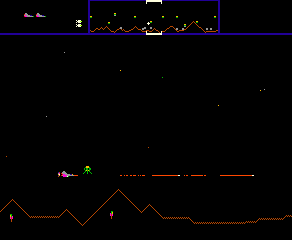
A long-range scanner at the top of the screen shows the positions of both the humanoids and the attacking aliens. The ideal strategy is to shoot down the alien ships before they reach the humanoids. If a humanoid is captured, the alien abductor can still be destroyed, but the player must then catch the falling humanoid and return it to the safety of the planet's surface before it falls to its death.
If an alien is allowed to carry its victim to the very top of the screen, the humanoid will mutate, becoming a permanent part of the alien that captured it. This new and deadly mutation will then immediately join in the alien attack.
The challenge becomes more intense as action progresses. Fighter ships and their mines will soon join the abductors. There are also mother ships that must be destroyed; these are particularly difficult as a direct hit smashes the mother ship into a swarming mass of mini-ships that must also be wiped out. Throughout the entire mission, the player must act quickly or face possible destruction by the cosmic baiter, a fast and dangerous enemy.
Players have two escape options to use as a last resort. The first is the 'smart bomb', which destroys all on-screen enemies. The second option is 'hyperspace', which randomly teleports the player's ship to another part of the level. This is highly risky as it may place the player's ship in a position more dangerous than the one it left.
If all humanoids are successfully abducted, the planet will explode in a blinding flash and the waves remaining until the next planet is reached take place in outer space, and consist solely of destroying enemy waves.
Board Number : D75 (top), D71F (A)
Prom Stickers : DF
Main CPU : Motorola M6809 (@ 1 Mhz)
Sound CPU : M6808 (@ 894.75 Khz)
Sound Chips : DAC
Players : 2
Control : 2-way joystick (vertical)
Buttons : 5
= > THRUST, FIRE, REVERSE, SMART BOMB, HYPERSPACE
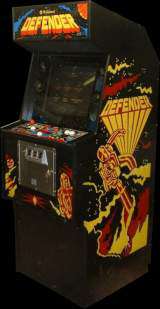
According to Defender development lead Eugene Jarvis: The game was shown at AMOA Chicago October 31, 1980 and released a week or two later on November 15, 1980.
Along with Namco's seminal Pac-Man, Defender shares the title of 'Highest Grossing Video Game of All Time' and to date has earned more than one billion dollars. It's interesting to note that when the now-legendary shoot-em-up was first shown at a 1981 Chicago arcade machine trade show, it was deemed to be a flop due to its high level of difficulty. Arcade industry insiders confidently predicted that both Defender and Pac-Man would be commercial flops and that Namco's Rally-X would be the next major arcade success.
Defender's attract mode for the game was programmed in just five hours.
Defender was noted for both its superb sound and visual effects and, moreover, for its extremely demanding gameplay. This didn't, however, stop players from accumulating millions of points when playing the game. Just minutes after the opening of the AMOA - an arcade industry trade show - Eugene Jarvis and his team - Defender's creators - were burning new ROMs for the game's display due to the fact they plugged the first burn into the board BACKWARDS and fried them. Due to the intimidating controls, hardly anyone at the show played the game and there were even rumours circulating suggesting that both Pac-Man and Defender would flop and that Namco's Rally-X would be the next big hit. Not only did Defender have the highest number of controls (five buttons, in addition to a two-way joystick) but it was also the first video game to feature an artificial 'world', in that game events occurred OUTSIDE the on-screen viewing area presented to the player.
Chris Hoffman holds the official record for this game on 'Marathon' settings with 79,976,975 points on January 1, 1984.
Bill Jones holds the official record for this game on 'Tournament' settings with 543,950 points on August 15, 2008.
Some bootlegs of this game are known as Star Trek 1981, Defence Command, Defense Command, Zero (Jeutel), and Tornado (Jeutel).
Defender inspired a catchy hit song by Buckner and Garcia called 'Defender' released on the 'Pac-Man Fever' album.
A Defender unit appears in the 1983 movie 'Terms of Endearment', in the 1983 movie 'Joysticks' and in the 1983 movie 'Koyaanisqatsi - Life out of Balance'.
The official video of the 1982 pop song "Herbergsvater", by Joachim Witt, begins by featuring a Defender unit and contains long scenes of Defender gameplay.
A mini Defender unit appears in the 1983 music video 'Almost Over You' by Sheena Easton.
MB (Milton Bradley) released a board game based on this video game (same name) in 1983: win the most points by using your Defender ships to protect Humanoids from waves of aliens. A set of chance cards will bring the different aliens (Bombers, Landers and Humanoids) into play. Movement is determined with a spinner. Players can move their defenders and aliens.
| Lander | 150 points. |
| Mutant | 150 points. |
| Baiter | 200 points. |
| Bomber | 250 points. |
| Pod | 1,000 points. |
| Swarmer | 150 points. |
| Completely destroying a pod with a smart bomb | 1,150, 1,300, 1,450, 1,600, 1,750, 1,900, or 2,050 points. |
| (The chances that a bombed pod will score 1,150, 1,300, or 1,450 points are 1/256 each.) | |
| Getting hit by an enemy bullet | 25 points. |
| Saving a humanoid from a Lander | 500 points. |
| Depositing a humanoid into the ground | 500 points. |
| Humanoid landing into the ground safely on his own | 250 points. |
| Bonus at the end of each wave | |
| Wave 1 | Humanoids Left X 100. |
| Wave 2 | Humanoids Left X 200. |
| Wave 3 | Humanoids Left X 300. |
| Wave 4 | Humanoids Left X 400. |
| Wave 5 and above | Humanoids Left X 500. |
 Atari 2600 (1981) Defender [Model CX2609] Atari 5200 (1982) Defender [Model CX5218] Entex Adventure Vision (1982) Defender [Model 6075]
  Emerson Arcadia (1982) Space Squadron Atari XEGS
  Atari 2600 (1983) Colecovision (1983) Defender [Model 70002] Mattel Intellivision (1983) Defender [Model 70252] Sega Genesis (1996) Williams Arcade's Greatest Hits Sega Mega Drive (1996) Arcade's Greatest Hits [Model T-97126-50] Sega Saturn (1996) Arcade's Greatest Hits [Model T-9703H] Sony PlayStation (apr.10, 1996) Williams Arcade's Greatest Hits [Model SLUS-00201] Sony PlayStation (sept.1, 1996) Williams Arcade's Greatest Hits [Model SLES-00323] Nintendo SNES (oct.1996) Williams Arcade's Greatest Hits [Model SNS-AW8E-USA] Nintendo SNES (jan.8, 1997) Williams Arcade's Greatest Hits [Model SNSP-AW8P-EUR] Sega Dreamcast (june.27, 2000) Midway's Greatest Arcade Hits Vol. 1 [Model T-9713N] Sega Dreamcast (jul.28, 2000) Midway's Greatest Arcade Hits Vol. 1 [Model T-9710D-50] Nintendo 64 (nov.14, 2000) Midway's Greatest Arcade Hits Vol. 1 [Model NUS-NAIE-USA] Sony PS2 (nov.18, 2003) Midway Arcade Treasures [Model SLUS-20801] Microsoft XBOX (nov.24, 2003) Midway Arcade Treasures Nintendo GameCube (dec.18, 2003) Midway Arcade Treasures [Model DOL-GAKE-USA] Microsoft XBOX (feb.6, 2004) Midway Arcade Treasures Sony PS2 (feb.6, 2004) Midway Arcade Treasures [Model SLES-51927] Microsoft XBOX 360 [XBLA] (nov.15, 2006) : Retired in 2010 Microsoft XBOX 360 (nov.6, 2012) Midway Arcade Origins Sony PlayStation 3 (nov.6, 2012) Midway Arcade Origins [Model BLUS-31083] Microsoft XBOX 360 (nov.15, 2012) Midway Arcade Origins Sony PlayStation 3 (nov.15, 2012) Midway Arcade Origins [Model BLES-01768] Nintendo Game Boy (1995) "Arcade Classic No. 4 - Defender & Joust [Model DMG-ADJP-UKV]" Nintendo Game Boy (oct.1995) "Arcade Classic No. 4 - Defender & Joust [Model DMG-ADJE-USA]" Nintendo Game Boy Color (mar.1999) "Arcade Hits - Joust & Defender [Model DMG-AADE-USA]" Nintendo Game Boy Color (apr.1999) "Arcade Hits - Joust & Defender [Model DMG-AADP-EUR]" Nintendo Game Boy Advance (nov.22, 2001) Midway's Greatest Arcade Hits [Model AGB-AM3E-USA] Nintendo Game Boy Advance (nov.30, 2001) Midway's Greatest Arcade Hits [Model AGB-AM3P-EUR] Sony PSP (dec.13, 2005) Midway Arcade Treasures Extended Play [Model ULUS-10059] Sony PSP (feb.24, 2006) Midway Arcade Treasures Extended Play [Model ULES-00180] Tandy Color Computer (1982) Starfire Tandy Color Computer (1982) Planet Invasion Tandy Color Computer (1982) "Offender" Atari 800 (1982) Defender [Model CXL4025] BBC B (1982) by Acornsoft Sinclair Zx-Spectrum (1982) Orbiter [Model 1] by Silversoft TI99/4a (1983) Defender [Model RX8506] Commodore C64 (1983) Commodore C64 (1983) Defender [Model RX8508] PC [Booter] (1983) Apple II (1983) Oric-1 (1983) Defence Force by Tansoft Commodore VIC-20 (1983) BBC B (1983) "Super Defender" by Acornsoft Acorn Electron (1984) Guardian by Alligata Acorn Electron Gauntlet by Micropower BBC B (1984) Guardian by Alligata BBC B Gauntlet by Micropower Sinclair ZX-Spectrum (1984) "Starblitz" by Softek Software Sinclair ZX-Spectrum (1984) Defenda by Interstella Software Commodore C64 (1984) Guardian by Alligata Commodore C64 (1985) "Guardian II" by Hi-tech Software Amstrad CPC (1985) Defend or Die by Alligata Amstrad CPC (1985) Gauntlet by Micropower Sinclair ZX-Spectrum (1986) Defenda by Interstella Software : 128k version improved sound/graphics. Sinclair ZX-Spectrum (1990) "Guardian II" by Hi-Tech Software Ltd 'UK' Atari ST (1990) Defender II by ARC developments, Atari UK, limited Commodore Amiga (1990) Defender II by ARC developments, Atari UK, limited Commodore Amiga (1991) "Zeron" by Acid software Commodore Amiga (1994) Defender : Shareware PC [MS Windows 3.1/DOS, CD-ROM] (1995) Williams Arcade Classics PC [MS Windows 95/DOS, CD-ROM] (1996) Williams Arcade Classics Sam Coupe (1998) by Persona PC [MS Windows, CD-ROM] (aug.27, 2004) Midway Arcade Treasures PC [MS Windows, CD-ROM] (nov.23, 2004) Midway Arcade Treasures Tangerine Microtan 65 Palm OS "Midway Arcade Classic" Tiger Game.com (1997) "Williams Arcade Classics [Model 71-722]" Mobile Phones (june.13, 2003) by THQ Wireless Apple App Store (feb.23, 2012) "Midway Arcade [Model 476467441]"