

![Centipede [Upright model]](images/marquees/427.jpg "Centipede [Upright model]")
![Centipede [Upright model] screenshot](images/game/427_1.png "Centipede [Upright model]")
Centipede © 1981 Atari.
Centipede is a vertically oriented single screen shoot-em-up in which the aim is to use the 'Bug Blaster' to shoot the centipedes that snake down towards the bottom of the screen to amass as high a score as possible.
The play-field is littered with randomly placed mushrooms and the rapidly descending Centipede changes direction when it runs into a mushroom. When a segment of the Centipede is shot, the segment is destroyed and a mushroom appears in its place, the Centipede then breaks into two smaller centipedes, each with its own head, and continues its descent.
Players can move the Bug Blaster vertically as well as horizontally, although only for the lower fifth of the play-field. Mushrooms can also be shot for points and to clear blocked areas. Once a Centipede reaches the bottom of the screen, it starts snaking back up, but remains within the lower section of the play-field near the player's Bug Blaster.
Additionally, any Centipede that reaches the very bottom of the screen without being shot releases its tail section which then becomes a new head. Other new heads also enter the screen from the bottom corners of the play-field as time progresses.
Randomly moving Spiders also appear in the first wave. Spiders can destroy any mushrooms they move over, eliminating many mushroom targets for a player. If the Bug Blaster and a Spider collide, both are destroyed. the Spider either moves at a 45-degree angle or vertically up and down, never simply left or right like the centipede does.
A bombardment of Fleas appears from the second wave onward. As a Flea descends, it leaves a trail of new mushrooms behind it. Fleas appear when a certain number of mushrooms remains at the bottom of the screen. This number increases as the game progresses, meaning Fleas appear more often later on in the game. The Bug Blaster must hit a Flea twice to destroy it; the first shot simply speeds up its descent.
When a Centipede with fewer than eleven segments appears, a Scorpion enters from either side, moving at a relatively slow speed. As the player earns more points, the Scorpion's speed increases. As the Scorpion travels across the screen, it 'poisons' the mushrooms that it moves over and changes their colours. These mushrooms cause any Centipedes that would collide with them to head straight towards the bottom of the screen, rather than continue snaking left and right. The Bug Blaster can stop a poisoned Centipede by shooting its head.
If a player earns at least 60,000 points, two things happen to increase the challenge: the Fleas descend at a faster speed and the Spiders restrict their movement to a smaller area at the bottom of the screen.
![Goodies for Centipede [Upright model]](images/covermini160/427_1.jpg)
Game ID : 136001
Height: 71 in. (180.34 cm)
Width: 26.75 in. (67.95 cm)
Depth: 25.25 in. (64.14 cm)
Main CPU : MOS Technology M6502 (@ 1.512 Mhz)
Sound Chips : POKEY (@ 1.512 Mhz)
Players : 2
Control : trackball
Buttons : 1 (FIRE)
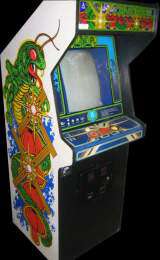
The original Upright model of Centipede was released on June 6, 1981 (even though the copyright at the bottom of the screen in the game's attract mode says 1980), selling at an MSRP of $1995. Exactly 46,062 units were produced. It's Atari's second bestselling coin-op game.
It was an Atari coin-operated game that swiftly won a wide following in the arcades. Apart from its smooth game play, Centipede was praised for its refreshing approach to screen colors and for its whimsical mushroom world.
Centipede was the first coin-op game to be designed by a woman - Dona Bailey. But Ed Logg did the majority of the work on Centipede; Dona only came up with the prototype idea, where the mushrooms were indestructible and it was more like Space Invaders. Like Pac-Man, this game has special appeal to women.
* The Creation of Centipede : Centipede was written by veteran Atari designer Ed Logg, who has become something of a legend in the world of video games, and a young game programmer who was credited with bringing a gentler touch to the world of video games with the enchanted mushroom patch.
Steve Calfee : 'Ed Logg is the world's greatest games designer. He's done the most, the best games. His line up starts with Asteroids, which probably still is the biggest run we ever did. He's in [a long line of games]. He's kind of like Pete Rose; he has the most hits and he's also probably got the most strike outs. He just goes up to bat.'
* Remembrances from the Video Game Masters : The mushroom patch with its tenacious, never-say-die centipedes, bouncing spiders, mushroom-laying fleas and transforming scorpions provided an imaginative leap for players, just as did the hoards of aliens in Tempest, the outer space adventures of Asteroids, the eerie battlefields of Battlezone and even the frightful scenarios of Missile Command. Of these times, and the games that emerged from Atari, Rich Adam said : 'We were a young group of fun people who were sort of treading on untrodden territory. We were out exploring what technology could do to entertain adolescent minds, and we were adolescent minds.'
In the early days of personal computers, before they became commonplace, and before sophisticated gaming programs were available for them, the arcades (and wherever else the coin-operated games were located) were the portals into these new fantasy worlds. And a river of quarters carried players into the electronic realms. Dan Pliskin described the coin-operated video game business as follows : "It was a wacky, extremely competitive business. I was there when coin-operated games were earning $8 billion in quarters a year. These games were out-grossing the record industry and the movie industry combined, in quarters! And when you looked at who was manufacturing these games, it was just a couple of Japanese companies and a few American companies.... There was incredible competition, all for kids' lunch and church money!"
The quarters are still rolling in. Dan Pliskin continued : "People say that video games have already seen their heyday and business has definitely gone downhill. Maybe it has gone downhill. Maybe it's only $4 billion worth of quarters now. It's still one heck of an industry."
* Popular from the Start : The prototype games were hand-built, wire-wrapped, one-of-a kinds that were created by the development team prior to ordering the circuit boards for the mass-produced versions. With just a single machine, people would come in at all hours of the night to play a new game.
Dan Pliskin : 'One of the things that kind of allowed everybody at Atari to have kind of a loose and enjoyable relationship was that management was kind of loose, too. An example of that happened with one of Howard Delman's games. I can't remember which one it was, but we sent the one and only prototype wire-wrapped version of Howie's game off to the AMOA (Amusement and Music Operators Association) show with strict orders not to sell it.'
Of course the game was sold anyway, and a new prototype had to be assembled back at the labs. Dan Pliskin continued : 'Several months later Howie gets a call from the person who bought this game. It had stopped collecting money and he wanted to know how to change the settings to make it play longer, or something, to see if it would earn more money. Howie had to tell the guy that if it ever collected any money at all, it was a miracle because it didn't have any coin routines at all. It had none, because we had wired it for free-play when we sent it to the AMOA show!'
* The Great 25-Cent Escape : Especially in the early 1980s a great many newspaper and magazine articles were written about the meaning of and possible consequences of the wave of video games that seemed to allure so many kids, and adults, to the arcades. But at the heart of it might have been the promise of a quick escape into another world.
Rich Adam : "I kind of figured out, maybe years after the fact, what I think the lure of video games is. It's because people have so little control over their lives. This is especially true with kids, but even adults often have little control over the day-to-day part of their lives. You have to go to work. You don't get to control that much of your life. But for a quarter you can control this very complex machine. You can command it. For a quarter that's quite a bargain, to be able to do that for five minutes... When you're good at a game it gives you an incredible sense of power over the whole environment.".
Centipede was the 1st UL (Underwriter's Laboratories) approved game.
Jim Schneider holds the official record for this game on 'Marathon' settings with 16,389,547 points on August 1, 1984.
Donald Hayes holds the official record for this game on 'Tournament' settings with 7,111,111 points on November 5, 2000.
Note 1 : The upright side artwork features a grasshopper, while it is not present during game-play. In test mode you can cycle through the different graphical objects used in the game (the player, a mushroom, a spider, a scorpion, a flea and a grasshopper). Grasshopper?! Yes, the game was to originally have had grasshoppers but they were taken out. You can still see them in the test however.
Note 2 : 'Centipede' is also the name of a terrifying, man-eating monster of the size of a mountain. This Japanese legend say that the dragon king of that particular lake asked the famous hero Hidesato to kill it for him. The hero slew it by shooting an arrow, dipped in his own saliva, into the brain of the monster. The dragon king rewarded Hidesato by giving him a rice-bag; a bag of rice which could not be emptied and it fed his family for centuries.
Centipede inspired a catchy hit song by Buckner and Garcia called 'Ode To A Centipede' released on the 'Pac-Man Fever' album.
The default high score screen of Cyberball 2072 features names of many Atari arcade games, including CENTIPED.
A Centipede unit appears in the 1982 movie "Fast Times at Ridgemont High", in the 1983 movie WarGames, in the 1983 movie "James Bond 007 - Never Say Never Again", in the 1983 movie Joysticks, in the 1984 movie "Body Double", in the 1985 movie "Teen Wolf", in the 1986 movie "Running Scared", in the 1987 movie "Death Wish 4 - The Crackdown", in the 1995 movie "Species" and in the 1996 movie 'House Arrest'.
In 1982, Atari released a set of twelve collector pins including : Missile Command, Battle Zone, Tempest, Asteroids Deluxe, Space Duel, Centipede, Gravitar, Dig Dug, Kangaroo, Xevious, Millipede and Food Fight.
MB (Milton Bradley) released a boardgame based on Atari's Centipede.
A Reimagined version of the Centipede franchise, was launched for the Nintendo 3DS and Nintendo Wii under name of "Centipede Infestation".
| Mushrooms & Poisoned Mushrooms | 1 point (Takes four hits to destroy) |
| Centipede (Body) | 10 points |
| Centipede (Head) | 100 points |
| Flea | 200 points (Takes two hits. First hit speeds it up, second hit destroys it) |
| Spider | 300, 600, 900 points (Points increase the closer the Spider is to the Bug Blaster when hit) |
| Scorpion | 1,000 points |
| When the mushroom patch is reset after a player loses a life, each partially destroyed/poisoned mushroom that is restored awards the player 5 bonus points. | |
 Atari 2600 (1982) Centipede [Model CX2676]
 Atari 2600 (1982) Centipede [Model CX2676P]
 Atari 2600 (oct.1983) Atari 5200 (1982) Centipede [Model CX5215] Colecovision (1983) Centipede [Model 70004] Mattel Intellivision (1983) Centipede [Model 70254] Atari 7800 (1987) Centipede [Model CX7801] Sega Master System (1992) Arcade Smash Hits [Model MK-27032-50] Sega Genesis (1996) Arcade Classics [Model MK-1715] Sega Mega Drive (1996) Arcade Classics [Model MK-1715-50] Sony PlayStation (dec.31, 1996) "Arcade's Greatest Hits - The Atari Collection 1 [Model SLUS-00339]" Sega Saturn (1997) Arcade's Greatest Hits - The Atari Collection 1 [Model T-25413H-50] Sega Saturn (june.30, 1997) Arcade's Greatest Hits - The Atari Collection 1 [Model T-9706H] Sony PlayStation (dec.1997) Arcade's Greatest Hits - The Atari Collection 1 [Model SLES-00466] Nintendo SNES (aug.1997) Arcade's Greatest Hits - The Atari Collection 1 [Model SNS-AW7E-USA] Nintendo SNES (feb.26, 1998) Arcade's Greatest Hits - The Atari Collection 1 [Model SNSP-AW7P-EUR] Sony PlayStation (2001) Atari Anniversary Edition Redux [Model SLUS-01427] Sega Dreamcast (jul.2, 2001) Atari Anniversary Edition [Model T-15130N] Sony PlayStation (mar.1, 2002) Atari Anniversary Edition Redux [Model SLES-03808] Microsoft XBOX (nov.16, 2004) Atari Anthology [Model 26084] Sony PS2 (nov.22, 2004) Atari Anthology [Model SLUS-21076] Microsoft XBOX (nov.26, 2004) Atari Anthology Sony PS2 (feb.18, 2005) Atari Anthology [Model SLES-53061] Microsoft XBOX (aug.4, 2005) Atari Anthology [Model B7X-00001] Microsoft XBOX 360 [XBLA] (may.2, 2007) "Centipede / Millipede" Sony PlayStation 4 (oct.18,2016) Atari Flashback Classics Vol.1 Microsoft XBOX One (nov.1,2016) Atari Flashback Classics Vol.1 Atari Lynx : Prototype only Nintendo Game Boy (1992) Centipede [Model DMG-CZ-FRG] Nintendo Game Boy (dec.1992) Centipede [Model DMG-CZ-USA] Nintendo Game Boy (aug.1995) "Arcade Classic No. 2 - Centipede & Millipede [Model DMG-ACPE-USA]"
 Nintendo Game Boy (aug.1995) "Arcade Classic No. 2 - Centipede & Millipede [Model DMG-ACPP-UKV]" Sega Game Gear (1996) Arcade Classics Nintendo Game Boy (1998) Centipede [Model DMG-AC4E-USA] Nintendo Game Boy Color (1998) Centipede [Model DMG-AC5E-USA] Nintendo Game Boy Color (nov.30, 1998) Centipede [Model DMG-AC5P-EUR] Nintendo GBA (mar.25, 2002) Atari Anniversary Advance [Model AGB-AAVE-USA] Nintendo GBA (feb.14, 2003) Atari Anniversary Advance [Model AGB-AAVP-EUR] Nintendo DS (mar.11, 2005) Retro Atari Classics [Model NTR-ATAE-UKV] Nintendo DS (mar.11, 2005) Retro Atari Classics [Model NTR-ATAE-EUR] Nintendo DS (mar.16, 2005) Retro Atari Classics [Model NTR-ATAE-USA] Nintendo DS (june.30, 2005) Atarimix Happy 10 Games [Model NTR-ATAJ-JPN] Nintendo GBA (aug.21, 2005) "3 Games in One! Breakout - Centipede - Warlords [Model AGB-B6ZE-USA]" Nintendo GBA (sept.9, 2005) "3 Games in One! Breakout - Centipede - Warlords [Model AGB-B6ZP]"
  Nintendo DS (nov.2007) Retro Atari Classics [Model NTR-ATAE-AUS] Sony PSP (dec.19, 2007) Atari Classics Evolved [Model ULUS-10325] Sony PSP (mar.7, 2008) "Atari Classics Evolved" Nintendo DS (nov.2, 2010) Atari Greatest Hits Vol.1 [Model NTR-BR6E-USA] Nintendo DS (feb.24, 2011) Atari Greatest Hits Vol.1 [Model NTR-BR6P-EUR] Atari 800 (1982) Centipede [Model CXL4020] BBC Micro (1982) Tandy Color Computer (1982) Katerpillar Attack Tandy Color Computer (1982) Caterpillar Tandy Color Computer (1982) "Colorpede" Tandy Color Computer (1983) Megapede Tandy Color Computer (1983) "Color Caterpillar" Apple II (1983) PC [Booter] (1983) Bug Blaster : A part of the "Friendlyware PC Arcade" suite PC [MS-DOS, 5.25"] (1983) "Centipede" PC [MS-DOS] (1983) "Centipede" : Unlicensed version by R. J. Grafe Commodore VIC-20 (1983) Commodore C64 (1983) Commodore C64 (1983) "Centipede [Model RX8505]" Memotech MTX 512 (1983) "Kilopede" BBC B (1983) Bug Blaster by Alligata TI99/4A (1983) "Centipede [Model RX8503]" Sinclair ZX-Spectrum (1983) Vectis Software Sinclair ZX-Spectrum (1983) "Spectipede" by R&R Software Ltd Sinclair ZX Spectrum (1983) "Centi-Bug" by Dk'tronics Amstrad CPC (1986) "Killapede" by Players Atari ST (1992) PC [MS Windows 3.1x, 3.5"] (1993) Microsoft Arcade PC [MS Windows, CD-ROM] (1999) Atari Arcade Hits 1 PC [MS Windows, CD-ROM] (jul.13, 1999) Atari Arcade Hits 1 PC [MS Windows, CD-ROM] (jul.9, 2001) Atari Anniversary Edition PC [MS Windows, CD-ROM] (dec.14, 2001) Atari Anniversary Edition PC [MS Windows, CD-ROM] (2003) "Centipede & Battlezone" PC [MS Windows, CD-ROM] (nov.11, 2003) Atari - 80 Classic Games in One! [Model 25069J] PC [MS Windows, CD-ROM] (june.10, 2005) "Atari - 80 Classic Games in One! [Replay]" Steam (mar.24,2016) "Atari Vault [Model 400020]" Tiger Game.Com (1999) [Model 71-755] Mobile phone (june.13, 2003) by iFone Limited Mobile Phones (jan.1, 2005) "Atari Legends Vol 1" Nokia N-Gage (feb.2006) Atari Masterpieces Vol. II Nokia N-Gage (mar.30, 2006) Atari Masterpieces Vol. II Mobile phones (2006) Apple iPhone/iPod (dec.5, 2008) "Centipede [Model 298862196]" Apple iPhone/iPod (jul.27, 2010) "Centipede 3GS [Model 382292863]" Apple iPhone/iPod (feb.9, 2011) "Centipede Ultra [Model 416011864]" Apple Store (2012) "Atari Greatest Hits" Google Play (2012) "Atari Greatest Hits"