

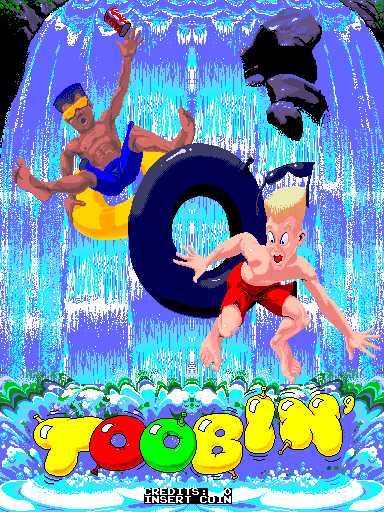
Toobin' © 1988 Atari Games Corp.
Toobin' is a unique fantasy-adventure game. 1 or 2 players can race Bif and Jet, the Toobin' dudes, in their inner tubes, down 45 different rivers. The players try to keep Jet and Bif afloat, avoiding sharp objects, gaining points, and throwing cans at obstacles. Toobin' appeals to both males and females of all ages who both find it just 'fun to play'.
Toobin' has a continuous buy-in feature so players can join in at any time. Toobin' has a color-coded control panel and players can identify Jet in the yellow inner tube and Bif in the black inner tube and red shorts.
Each player has a set of four buttons to steer Bif or Jet forwards, backwards, and sideways. Pressing the two Paddle Forward buttons moves the inner tube forward. Pressing the two Back Paddle buttons moves the inner tube backwards. Pressing only one Paddle button makes the inner tube turn. The player uses the Throw Can button to destroy obstacles in the river and stun riverside pests.
Toobin' players can enjoy amusing game play and an incredible variety of rivers and environments for their long-term enjoyment.
The player races Bif or Jet against other players, or against the game, down Toobin's 45 different rivers, paddling through six classes of play, and cruising the 15 unique river environments. The player can choose almost 200 courses through the rivers, finding his own way through rapids, obstacles, riverside pests and waterfalls.
The player has to guide Bif or Jet around obstacles, go through gates and pick up treasure to accumulate points to get more inner tube patches, collect cans to throw at obstacles and to stun riverside pests, and paddle fast enough to avoid the big 'gator lurking in all the rivers.
At the finish line, players are treated to a party. Each party grows in size until the player reaches the final super party at the end of the game.
Inner-Tube Patches : At the beginning of each game, the player has a certain number of inner-tube patches, which represent game lives. A player receives extra patches by scoring the number of points required for another patch. The number of points required changes from level to level, and is displayed in the lower left and right corners of the playfield. A player can also receive more patches by picking up patches floating in the rivers.
Cans : The player must accumulate cans to throw at obstacles and pests. All cans are the same value. The player can pick up individual cans floating in all the rivers or six-packs hidden under obstacles or in back waters (Six packs give unlimited cans). The player throws the cans by pointing Bif or Jet at the obstacle and pressing the Throw Can button.
Most of the obstacles in the river can be eliminated by hitting them with a can.
Dangers : The player must avoid or eliminate dangers in the river and stun pests on the river banks. The dangers in the river include falling rocks, floating logs, deadly falling coconuts, icebergs, mines, stampeding cattle, snakes, crocodiles, barbed wire, and thorny bushes.
Dangerous riverside pests throw and shoot objects at Bif and Jet. The player can stun most of these objectionable characters with a can thrown in their direction. These pests include Casting fishermen, Hillbillies, Terrorists, Devils, Martians, Street punks, Pistolaros, Natives, Penguins, Bears, Dinosaurs, and Cavemen.
Big 'Gator : If a player is slow, the big 'gator comes up from behind to discourage slow play and hurry the player through the gates. A loud thumping sound warns the player of its presence. One escape from the big 'gator is to quickly paddle downstream or pass through a gate. If the gator catches Bif or Jet, one inner-tube patch is lost.
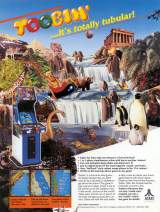
Game ID : 136061
Main CPU : Motorola 68010 (@ 8 Mhz), MOS Technology 6502 (@ 1.7895 Mhz)
Sound Chips : Yamaha YM2151 (@ 3.579 Mhz), POKEY (Pot Keyboard Integrated Circuit) (@ 1.7895 Mhz)
Players : 2
Buttons : 5
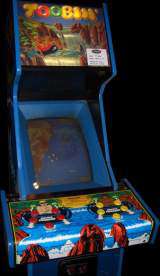
Toobin' was released in June 1988.
1500 units were produced in the USA. The selling price was $2395. This was an unique cabinet (as did many Atari games of the time) that featured a large marquee behind which were two rotating drums, designed to give the impression of a flowing waterfall.
Toobin' was a classic example of Atari's genius approach to abstract game design, that would typify their heyday of the mid-to-late 80s.
Per the game designer, Dennis Harper: "Toobin' was my favorite game to make. It was totally my idea and creation. I hijacked mechanical designer Milt Loper into being a playfield designer. I wrote this complex tile-based playfield editor that made making playfields super quick. That's how just Milt and I cracked out dozens and dozens of the levels. Also, I am a fairly experienced musician, and I got to direct the music team to create super-unique tunes for each world. Generally, a ton of fun.
It took 4-5 months just to get the concept right. It was originally a kayaking simulator (hence the gates in the rapids). We even developed a custom "rowing" controller, based on the Star Wars gimbal. But we soon learned that people didn't understand how to row a kayak and were having no fun at all. Then, after playing a lot of Track and Field I came up with a way to re-use the "river technology" in a new, fun way. The Atari management showed patience and was always encouraging. Thank you Dan Van!"
The default high score screen of Cyberball 2072 features names of many Atari arcade games, including TOOBIN.
Special Contest Feature : Every Toobin' game in the U.S. has a special contest. A player can win a free Toobin' t-shirt just for playing the game and finding and picking up all seven characters to spell the word Toobin' (including the apostrophe). These characters are hidden in the river below obstacles and hazards. The letters collected by the player are shown at the beach party at the end of the run. For more contest details, see the game (The offer expired December 1, 1988).
| The player can score points by | |
| * Time of Travel | The player receives points simply for traveling down the river. |
| * Passing through Gates. The player receives points for passing through the gates in the river. Different colored gates are worth different amounts of points. The green gates give the lowest points, then the red, gold, and finally crystal gates give the highest points. | |
| If a players swishes a gate, that is, paddles through it without hitting the poles, he adds to his Score Multiplier (This is described in Score Multiplier below). For maximum points, the player should be the first through the gate and swish the gate. Each time the gate poles are hit, the point value of the gate falls. | |
| * Score Multiplier. If a player swishes the gate, the score is multiplied. Each gate that is swished adds to the multiplier. For example, if the player has a 2X multiplier, each point scored is multiplied by 2. | |
| Every point the player scores is multiplied by the score multiplier. The score multiplier is shown in the upper left and right of the playfield, underneath the game scores. The minimum multiplier is 1 and the maximum is 5. The player must pass through every gate (whether he swishes it or not) to maintain the score multiplier. If the player misses a gate, the score multiplier is reduced by one. As long as the player passes through the gate, even if he bumps it, the score multiplier is maintained. However, if a player's tube is punctured, his score multiplier falls to one. | |
| * Treasures. The player can pick up treasures floating on the river or hidden under obstacles to gain extra points. The lowest-value treasure is green, next is red, and gold is the highest. | |
| * Warp. The warp feature moves the player to the intermediate or advanced play classes. When the player warps, he is rewarded with warp bonus points. Warping is a good way to quickly score points. | |
 Atari 7800 : Unreleased prototype Nintendo NES (1989) Sony PlayStation (sept.30, 1999) Arcade Party Pak [Model SLUS-00952]
 Sony PlayStation (feb.23, 2001) Arcade Party Pak [Model SLES-02339] Sony PS2 (nov.18, 2003) Midway Arcade Treasures [Model SLUS-20801] Microsoft XBOX (nov.24, 2003) Midway Arcade Treasures Nintendo GameCube (dec.18, 2003) Midway Arcade Treasures [Model DOL-GAKE-USA] Microsoft XBOX (feb.6, 2004) Midway Arcade Treasures Sony PS2 (feb.6, 2004) Midway Arcade Treasures [Model SLES-51927] Microsoft XBOX 360 (nov.6, 2012) Midway Arcade Origins Sony PlayStation 3 (nov.6, 2012) Midway Arcade Origins [Model BLUS-31083] Microsoft XBOX 360 (nov.15, 2012) Midway Arcade Origins Sony PlayStation 3 (nov.15, 2012) Midway Arcade Origins [Model BLES-01768] Nintendo Game Boy Color (may.18, 2000) Toobin' [Model CGB-AOIE-USA] Sony PSP (dec.13, 2005) Midway Arcade Treasures Extended Play [Model ULUS-10059] Sony PSP (feb.24, 2006) Midway Arcade Treasures Extended Play [Model ULES-00180] MSX (1988) Amstrad CPC (1989) Commodore C64 (1989) Commodore Amiga (1989) Atari ST (1989) Sinclair ZX Spectrum (1989) PC [MS-DOS] (1992) PC [MS Windows, CD-ROM] (aug.27, 2004) Midway Arcade Treasures PC [MS Windows, CD-ROM] (nov.23, 2004) Midway Arcade Treasures