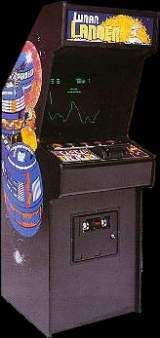
Lunar Lander © 1979 Atari.
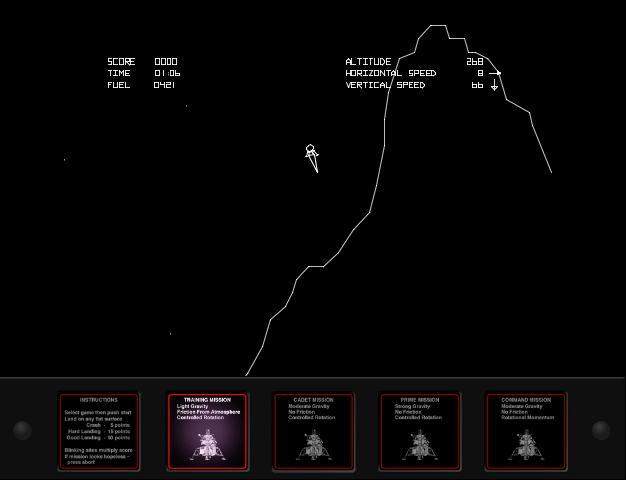
Lunar Lander is a 1-player coin-op electronic game that simulates landing a manned spaceship on the moon. Various video-display phrases indicate score, time elapsed during this landing mission, fuel units consumed, altitude above the moon, and horizontal and vertical speed. The fuel consumption and both speed readings are important for the player to determine how to land the craft. Realistic engine rumble and crash sounds accompany game play. A high beep warns of an almost-depleted fuel supply, whereupon players can add coins to automatically extend the game and 'fill up' their fuel tanks. Depending on the quality of the landing or the crash, various messages are displayed on the screen.
Game play begins with engine rumble and the lander drifting towards the bottom
right corner of the screen. Horizontal and vertical speeds are constantly displayed, including two arrows to show horizontal and vertical directions of travel. Altitude is measured in distance above the surface of the mountain - not above 'sea level'. The screen also shows time in actual seconds, representing time elapsed in the current mission.
The operator can select from four different settings for fuel units - 450, 600, 750 or 900 fuel units per coin (free play is also available). As the lander module flies over the landscape, it approaches the mountains and a landing site. At a certain point near the mountains, the game 'zooms in' for a close-up view of everything on the screen.
If the player realizes the speed is too fast and the landing looks hopeless, he or she can press the ABORT button on the control panel. This will give the lander extra thrust and make it fly upwards at top speed. The abort feature does consume 120 to 180 fuel units, though, as a disincentive to overusing it. If the ABORT button is pressed too late, however, a crash cannot be avoided.
The four levels of mission difficulty are determined by the player and can be changed at any time during the game or the ready-to-play mode. The differences between the four are printed on the mission select panels and are self explanatory, except perhaps rotational momentum. This feature causes the lander to tumble around when either ROTATE button is pushed. The longer either button is held down, the faster the lander module will spin in that direction. The player gains control of the lander by pressing the other ROTATE button for the same amount of time.
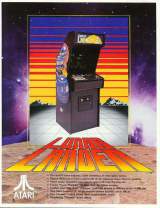
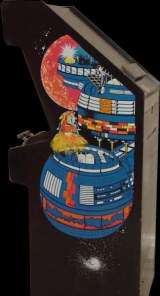
Lunar Lander came in a large black upright cabinet, which was a little heavier than most. The sideart is a (predominately blue); there is no front art at all, and the monitor bezel is relatively clear of decals. The marquee features a 'Lunar Lander' blasting off from the surface of the moon (some of these have a black background, while others have blue, it appears that there were 2 print runs of these).
Cabinet dimensions : 25.25 in. (64.14 cm) wide x 32 in. (81.28 cm) deep x 71.87 in. (182.54 cm) high.
Cabinet monitor : 19-in. B/W
Game ID : 0345xx
Main CPU : MOS Technology M6502 (@ 1.512 Mhz)
Sound Chips : Discrete
Screen orientation : Horizontal
Video resolution : Vector, capable of 1024 x 768 static points, infinite resolution of lines in between.
Screen refresh : Dynamic, varies depending on how many vectors are drawn on screen at once.
Palette colors : 16 levels of grey.
Players : 1
Control : Lever (increase or decrease the THRUST)
Button : 3 (ROTATE LEFT, ROTATE RIGHT, ABORT)
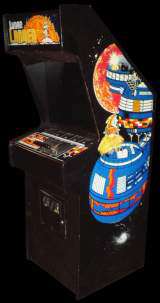
Lunar Lander was released in August 1979, selling at an MSRP of $1695. Approximately 4,830 units were produced.
Licensed to Sega for Japanese market.
Lunar Lander was Atari's first vector game and was inspired by Moonlander, a game written by Jack Burness in 1973 as a demo for the DEC GT40 vector graphics terminal (based on a PDP-11/05 CPU). This game used a light pen to control thrust and rotation.
If the player landed at exactly the right spot, a McDonalds appeared. The astronaut would leave the lander and walk over to the McDonalds and order a Big Mac to go, before walking back to the Lander and taking off again. If players crashed directly into the McDonalds, the game displayed a message reading 'You clod. You've destroyed the only McDonald's on the Moon.' After a short run of Lunar Lander machines were manufactured, production was shifted over to Asteroids and the first few hundred Asteroids machines were housed in Lunar Lander cabinets. Atari donated a gold edition version of the coin-operated video game to the Discovery Center of Science & Technology in Syracuse, New York.
On June 17, 1980, Atari's Asteroids and Lunar Lander were the first two video games to ever be registered in the Copyright Office.
Jonathan Turner holds the officially recognized world record for this game (certified via Twin Galaxies) with 2,175 points. This was achieved using a single credit and 750 units of fuel which are the default settings for this game.
A Lunar Lander units appears in the 1984 movie 'The Philadelphia Experiment'.
| The scoring system gives 50 points for a good landing, plus 50 fuel units as a bonus. A hard landing earns only 15 points, and a crash earns 5 points. A crash happens when the vertical speed exceeds 15 and the horizontal speed exceeds 31. The number displayed after SCORE is cumulative of all landings made in the current game. The point scores for a good or hard landing can be greatly increased by landing on an area with a flashing multiplier, for example 2X or 5X. Thus, a good landing on the very narrow 5X site would give that player 250 points. |
 Microsoft XBOX (nov.16, 2004) Atari Anthology [Model 26084] Sony PS2 (nov.22, 2004) Atari Anthology [Model SLUS-21076]
  Microsoft XBOX (nov.26, 2004) Atari Anthology Sony PS2 (feb.18, 2005) Atari Anthology [Model SLES-53061]
  Microsoft XBOX (aug.4, 2005) "Atari Anthology [XBOX World Collection] [Model B7X-00001]" Sony PlayStation 4 (oct.18, 2016) Atari Flashback Classics Vol.1 Microsoft XBOX One (nov.1, 2016) Atari Flashback Classics Vol.1
  Nintendo DS (mar.11, 2005) Retro Atari Classics [Model NTR-ATAE-UKV] Nintendo DS (mar.11, 2005) Retro Atari Classics [Model NTR-ATAE-EUR] Nintendo DS (mar.16, 2005) Retro Atari Classics [Model NTR-ATAE-USA] Nintendo DS (june.30, 2005) Atarimix Happy 10 Games [Model NTR-ATAJ-JPN] Nintendo GBA (aug.15, 2005) "3 Games in One! Super Breakout - Millipede - Lunar Lander [Model AGB-B62E-USA]" Nintendo GBA (sept.2, 2005) "3 Games in One! Super Breakout - Millipede - Lunar Lander [Model AGB-B62P-EUR]"
  Nintendo DS (nov.2007) Retro Atari Classics [Model NTR-ATAE-AUS] Sony PSP (dec.19, 2007) Atari Classics Evolved [Model ULUS-10325] Sony PSP (mar.7, 2008) "Atari Classics Evolved" Nintendo DS (nov.2, 2010) Atari Greatest Hits Vol.1 [Model NTR-BR6E-USA] Nintendo DS (feb.24, 2011) Atari Greatest Hits Vol.1 [Model NTR-BR6P-EUR] PC [Booter] (1983) "Eagle Lander" : Part of the "Friendlyware PC Arcade" suite Tandy Color Computer (1983) Lander Tandy Color Computer 3 (19??) PC [MS Windows, CD-ROM] (nov.11, 2003) Atari - 80 Classic Games in One! [Model 25069J] PC [MS Windows, CD-ROM] (june.10, 2005) "Atari - 80 Classic Games in One! [Replay]" Steam (mar.24, 2016) "Atari Vault [Model 400020]" Microtan 65 VTech Laser-VZ Nokia N-Gage (2005) "Atari Masterpieces Vol. I" Atari Flashback 2 (2005) Nokia N-Gage (oct.13, 2005) "Atari Masterpieces Vol. I" Atari Flashback 2+ (2010)