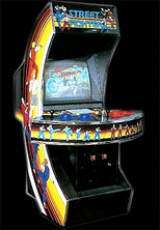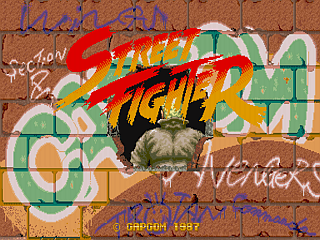
Street Fighter © 1987 Capcom Company, Limited.
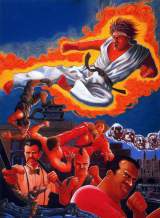
Martial arts masters Ryu and Ken enter a worldwide martial arts tournament spanning 5 nations as they face 10 of the world's greatest fighters. The game can be played alone or with 2 players competing, with Player 1 taking the role of Ryu and Player 2 as Ken. The predecessor to the ultra-popular "Street Fighter II - The World Warrior".
Main CPU: Motorola 68000 (@ 8 Mhz)
Sound CPU: (2x) Zilog Z80 (@ 3.579545 Mhz)
Sound Chips: Yamaha YM2151 (@ 3.579545 Mhz), (2x) MSM5205 (@ 384 Khz)
Screen Orientation: Horizontal
Video Resolution: 384 x 224 Pixels
Screen Refresh: 60.00 Hz
Palette Colors: 1024
Players: 2
Control: 8-Way Joystick
Buttons: 6
= > [1] LP (Jab), [2] MP (Strong), [3] HP (Fierce)
= > [4] LK (Short), [5] MK (Forward), [6] HK (Roundhouse)
Street Fighter was released on August 30, 1987.
Capcom's first head-to-head fighting game, Street Fighter is also the first fighting game to feature:
- 6 buttons (or 2 pressure pads) and 8 way joystick.
- 2 playable characters and ten CPU-controlled opponents .
- Special moves.
Two versions of the game's cabinet were produced. A standard version with the 6-button configuration later used by its sequels ("Street Fighter II - The World Warrior") and a deluxe cabinet that featured 2 pressure sensitive pads for punches and kicks that determine the strength and speed of the player's attacks based on hard they were pressed.
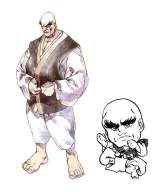
Ryu, Ken and Sagat were the only characters to return in the immediate sequel "Street Fighter II - The World Warrior". Birdie and Adon would later return in "Street Fighter Alpha - Warriors' Dreams", followed by Gen in "Street Fighter Alpha 2" and Eagle in "Capcom Vs. SNK 2 - Mark of the Millennium 2001". The character of Mike is believed to a precursor to Balrog from Street Fighter II, whose name in Japan is M. Bison (with the M standing for Mike).
Ryu and Sagat were mostly based on 'Yoshiji Soeno', a 'Kyokushin Karate legend' and 'Reiba', the 'Dark Lord of Muaythai' from an old Japanese martial art comics called 'Karate Baka Ichidai'.
In the England (Birdie) stage a poster for 'The Velvet Underground' (a cult 1960's rock band) is clearly visible alongside another poster for 'Ian Dury and the Blockheads'. The Blockheads were a popular British pub-rock band who disbanded in 1982 but reformed in 1987 for a tour of Japan, two months before the release of this game. A third poster advertises 'Ristorante Donnaloia' an expensive Italian restaurant in Kobe, which still exists to this day. Also on this stage the name and likeness of at that time Capcom USA Vice President of Sales and Marketing 'Bill Cravens' is grafittied on the shutter in front of the 'Block Heads' pub.
The title screen has several Capcom games listed on the brick wall: "Avengers", "Commando", Wings ("Legendary Wings"), and "Trojan".
In May 1988, Pony Canyon released a Game Simulation Video VHS tape featuring approx. 20 minutes of gameplay footage from this game.
Alfa Records released a limited-edition soundtrack album for this game (Capcom Game Music Vol.2 - 28XA-203) on March 25, 1988.
A Street Fighter unit can be seen in the 1992 film 'Juice' starring Omar Epps and the late Tupac Shakur.
The Japanese version :
* Has different words spoken for Ryu and Ken during their special moves than the other versions. Ryu and Ken shout 'hadoken!', 'shoryuken!' and 'tatsu-maki-senpuu-kyaku!' during respective special moves in the Japanese version, while they shout 'hellfire!', 'dragon punch!' and 'hurricane!' on all other versions.
The prototype version :
* Has no demo mode.
* Different colors on highscore table.
* Different hole on in the wall during the title screen.
* Is highly bugged.
* No digitized voice samples.
* Characters share stage music.
* Ryu's victory pose is visually different.
* Different sound effects for everything.
* Different intro/outro music.
* Must win three rounds to win the match.
* Typo in victory quote screen, 'Rut Don't Forget...' instead of 'But Don't Forget...'.
* No stage select when you start the game.
* The Hurricane Kick does not seem to be in the game.
Performing special moves : Unlike pretty much every other fighting game, this game requires the player to "release" the buttons instead of pressing them to attack. This applies to special moves as well. A tip to do them easily is to hold the attack button as soon as you start the motion and release it as soon as you finish it.
Turtling with Mike : When fighting Mike, you can turtle-up in the corner and he will just repeatedly throw low punches at you (which you can block). You can use this to your advantage by letting time run out if you have more energy than he does.
Single-Move Victory with Birdie : When fighting Birdie, if you do a hurricane kick right at the start of the round, you can 'sometimes' get him will all of the kicks (he will not be knocked back) and defeat him with that one move alone.
1. Street Fighter (1987)
2. Street Fighter II - The World Warrior [B-Board 90629B] (1991)
3. Street Fighter II' - Champion Edition [B-Board 91634B-2] (1992)
4. Street Fighter II' - Hyper Fighting [B-Board 91635B-2] (1992)
5. Super Street Fighter II - The New Challengers [Green Board] (1993)
6. Super Street Fighter II Turbo [Blue Board] (1994)
7. Street Fighter Alpha - Warriors' Dreams [Blue Board] (1995)
8. Street Fighter Alpha 2 [Blue Board] (1996)
9. Street Fighter III - New Generation (1997)
10. Street Fighter III - 2nd Impact : Giant Attack (1997)
11. Street Fighter Alpha 3 [Blue Board] (1998)
12. Street Fighter III - 3rd Strike : Fight For The Future (1999)
13. Hyper Street Fighter II - The Anniversary Edition [Green Board] (2003)
14. Street Fighter IV (2008)
15. Super Street Fighter IV - Arcade Edition (2010)
16. Ultra Street Fighter IV (2014)
17. Street Fighter V (2016)
18. Ultra Street Fighter II - The Final Challengers (2017, Switch)
Direction : Takashi Nishiyama (Piston Takashi)
Planner : Hiroshi Matsumoto (Finish Hiroshi)
Programmer : Fz 2151
Character Designers : Crusher Ighi, Dabada Atsushi, Bonsoir Yuko, Ocan Miyuki, Bravo Ovu, Innocent Saicho
Sound & Music : Yoshihiro Sakaguchi
Hard Planner : Punch Kubozo
Mechatronics : Strong Take, Radish Kamin
Special Thanks : Short Arm Seigo, Melanin Kazu, Puttsun Midori (Puttun Midori), James Nyama, Seinto Sinn
CONSOLES:
 NEC PC-Engine CD-ROM (dec.4, 1988) "Fighting Street [Model HCD8002]"
 NEC TurboGrafx-CD (1989) "Fighting Street [Model TGXCD1001]"
Microsoft XBOX (nov.24, 2006) "Capcom Classics Collection Vol. 2"
Sony PS2 (nov.24, 2006) "Capcom Classics Collection Vol. 2 [Model SLUS-21473]"
 Sony PlayStation 2 (apr.11, 2007) "Capcom Classics Collection Vol. 2 [Model SLES-54561]"
 Sony PS2 (apr.13, 2007) "Capcom Classics Collection Vol. 2 [Model SLES-54561]"
HANDHELDS:
Sony PSP (mar.22, 2006) "Capcom Classics Collection Remixed [Model ULUS-10097]"
Sony PSP (jul.21, 2006) "Capcom Classics Collection Remixed [Model ULES-00347]"
COMPUTERS:
Amstrad CPC (1988)
Atari ST (1988) by Go!
Commodore Amiga (1988)
Commodore C64 (1988)
PC [MS-DOS] (1988)
Sinclair ZX Spectrum (1988) by Go!
Commodore C64 (june.1988)
 Amstrad CPC (1990) "10 Jeux Spectaculaires"
PC [MS Windows, CD-ROM] (2003) "Capcom Arcade Hits Vol. 1"
Game's picture.
Game's ROMs.
Game's screenshots.
See goodies section.
 Info
Info Music (23)
 Goodies (17)
 Video (2)
 ROM
ROM DIP Switch
 Edit
Edit Upload
 Add
Add