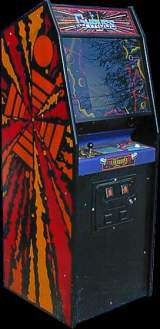
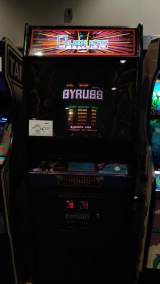
![Gyruss [Model GX347]](images/marquees/1063.jpg "Gyruss [Model GX347]")
![Gyruss [Model GX347] screenshot](images/game/1063_1.png "Gyruss [Model GX347]")
Gyruss © 1983 Konami Industry Company, Limited.
Gyruss is a single-player shoot-em-up in which the purpose is to fly through the solar system, destroying waves of alien attackers, before finally reaching Earth. Planets that must be passed before Earth is reached are Neptune, Uranus, Saturn, Jupiter, and Mars.
It only takes two warps to reach Neptune, but all of the others, including Earth, take three warps to get to. Each time the player reaches a planet, they will be faced with a 'Chance Stage', a bonus stage in which players try to destroy as many aliens as possible to accrue points. After reaching Earth, there is a Chance Stage, followed by a very fast '3 Warps to Neptune' stage. After this, the levels and the background music start over.
Gyruss' superb gameplay, in which the player ship rotates around the edges of the screen and fires 'inwards', is heavily influenced by Atari's 1981 classic, Tempest. While the design of the alien ships themselves is similar to those of Namco's also-legendary Galaga series.
Game ID : GX347
Main CPU : Zilog Z80 (@ 3.072 Mhz), M6809 (@ 2 Mhz)
Sound CPU : Zilog Z80 (@ 3.579545 Mhz), I8039 (@ 533.333 Khz)
Sound Chips : (5x) AY8910 (@ 1.789772 Mhz), DAC, (6x) RC (@ 1.789772 Mhz)
Players : 2 (Alternating)
Control : 8-Way Joystick
Buttons : 1
=> Fire
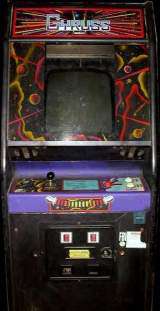
Gyruss was released in March 1983 in Japan.
After working on the successful Time Pilot, Gyruss' designer, Yoshiki Okamoto, went on to create Gyruss, which, although a success in its own right, was released at a time when the arcade craze was starting to die down. This may explain why the game didn't shift the units it really deserved. After its release, Okamoto asked for a raise, or he would quit. He was duly fired when he turned up for work the following day.
One of the most memorable features of this game is its soundtrack, which consists of an extremely catchy synthesized rendition of Bach's 'Tocatta and Fugue in D Minor'.
Anthony Fodrizio holds the official record for this game with 41,090,450 points.
A set of developer credits are hidden in the ROM, beginning at 1E9A in memory.
A bootleg of this game is known as Venus.
Alfa Records released a limited-edition soundtrack album for this game (Konami Game Music Vol.1 - 28XA-85) on June 25, 1986.
A Gyruss unit appears in the music video for "Kid Candy" by the grunge rock group Seaweed.
| Shooting a ship | 50, 100 or 150 points. |
| Destroying a whole formation of enemy ships before the next wave attacks | 1,000, 1,500, 2,000, 2,500 points. |
| Bonus for clearing a sector (having not destroyed a whole formation) | 1,000 points. |
| Shooting the three glowing spheres | 1,000, 1,500, 2,000 points. |
| Bonus for shooting each ship on the Chance Stage | 100 points. |
| Bonus for shooting all 40 ships on the Chance Stage | 10,000 points. |
 Nintendo NES (1988)
  (nov.18, 1988) Gyruss [Model KDS-GRS] Sony PlayStation (may.13, 1999) Konami 80's Arcade Gallery [Model SLPM-86228] (apr.18, 2007) Nintendo GBA (may.2, 2002) Konami Arcade Game Collection [Model AGB-AKCJ-JPN] Nintendo GBA (june.21, 2002) Konami Collector's Series - Arcade Classics [Model AGB-AKCP-EUR] Commodore C64 (1984)
 (nov.1998) "Konami 80's AC Special" (nov.1998) "Konami 80's Arcade Gallery" (2004)